



2026 // Week 17 – Vietnam Pepper Market: Stability, Strategy & the Green Transformation
Domestic Price Stability: A Market in Consolidation
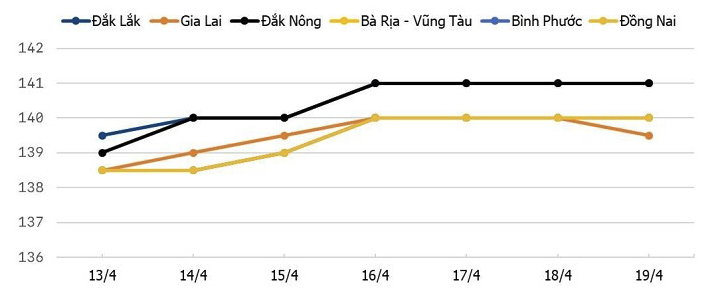
Price trends of pepper in the Central Highlands and Southeast regions during the week from 13-April to 19-April.
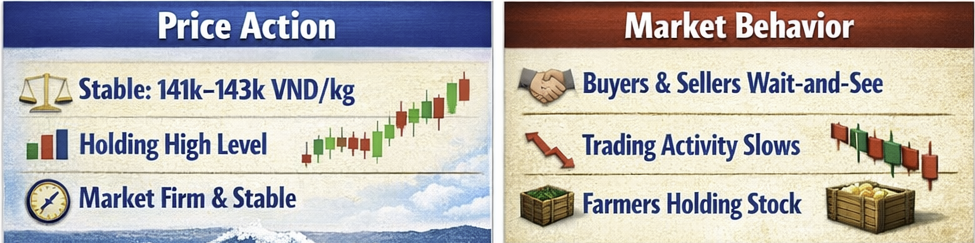
After weeks of sharp fluctuations, Vietnam’s domestic pepper market has entered a period of relative calm. Prices are holding steady at 141,000 to 143,000 VND per kilogram, reflecting a market where both buyers and sellers have adopted a cautious, wait-and-see posture. Trading volumes have slowed noticeably as participants reassess their positions amid shifting global signals and an uncertain harvest outlook.
This stability is not accidental. Following a period of strong volatility driven by speculative buying, weather disruptions, and shifting export demand, the market appears to be self-correcting. Buyers are reluctant to commit at elevated prices without clearer signals from international markets, while sellers — particularly farmers — are holding back inventory in hopes of better pricing as the harvest season draws to a close.
- Buyers: cautious, limited purchasing
- Sellers: holding inventory, expecting higher prices
- Overall: technical pause before next cycle
The limited supply entering the market, despite the harvest season nearing its end, is a key factor supporting current price levels. Farmers are demonstrating increased market sophistication by timing their sales rather than flooding the market at harvest peak — a behavioral shift that could have long-term implications for price stability and farmer income across Vietnam’s pepper-growing regions.
Global Price Pressures: Competition from Brazil & Indonesia

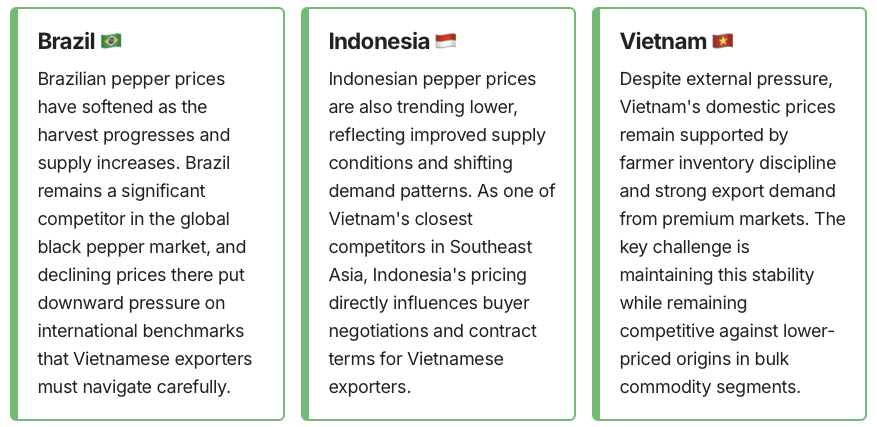
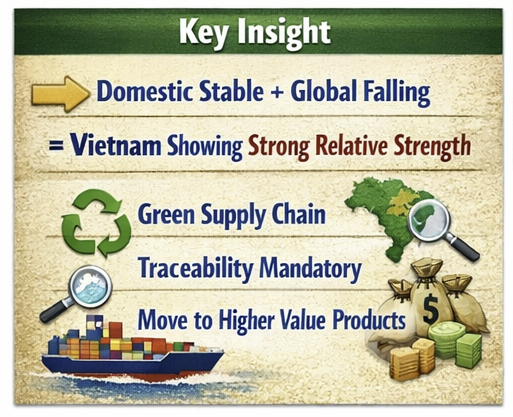
While Vietnam’s domestic market enjoys relative stability, the global pepper landscape is sending mixed signals. Prices in major competing markets — particularly Brazil and Indonesia — have begun to decline, creating a complex competitive environment for Vietnamese exporters. This divergence between domestic stability and international softening is one of the most important dynamics shaping the current market cycle.
Market Phase: A Necessary Technical Pause
One of the most notable features of the current market is the behavior of farmers themselves. Despite the harvest season nearing its end, actual supply entering the market remains limited. Farmers across Vietnam’s key pepper-growing provinces — including Bà Rịa–Vũng Tàu, Đắk Lắk, and Gia Lai — are choosing to hold inventory rather than sell at current prices, betting on better rates in the coming months.
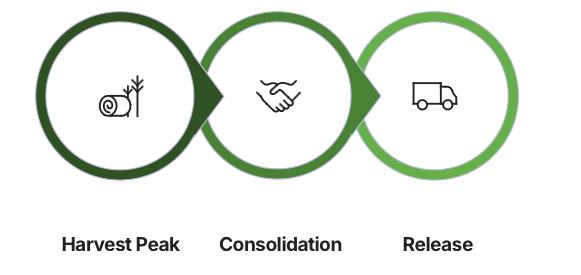 This inventory-holding strategy reflects a maturing understanding of market dynamics among Vietnamese pepper farmers. In previous years, harvest-season flooding of the market led to price collapses that hurt farmer incomes and created boom-bust cycles. Today, farmers are increasingly coordinated — often through cooperatives and trader networks — in managing the timing and volume of their sales.
Why Farmers Are Holding Inventory
- Anticipation of better prices post-harvest
- Reduced urgency as domestic prices remain elevated
- Improved market information and coordination
- Experience from previous price cycles
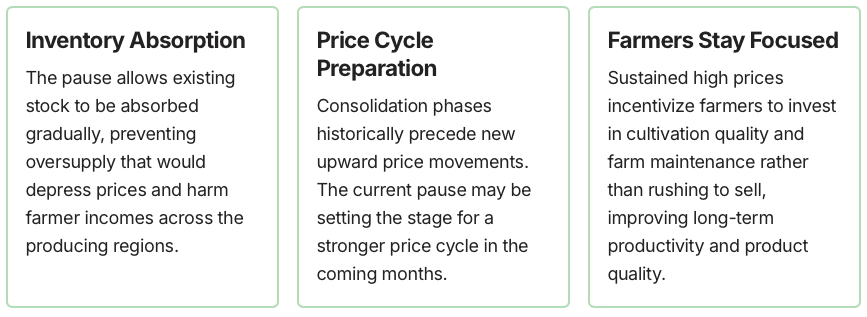
Experts believe this is a necessary technical pause for the market to absorb existing inventory and prepare for a new price cycle. Maintaining high price levels also encourages farmers to focus on cultivation rather than selling aggressively.
The Green Transformation: Meeting Global Standards
While price dynamics dominate short-term market discussions, Vietnam’s pepper industry is simultaneously engaged in a far more consequential long-term project: accelerating its green transformation to meet the increasingly stringent export standards of the European Union and the United States. This transformation is not optional — it is becoming a prerequisite for market access in the highest-value export destinations.
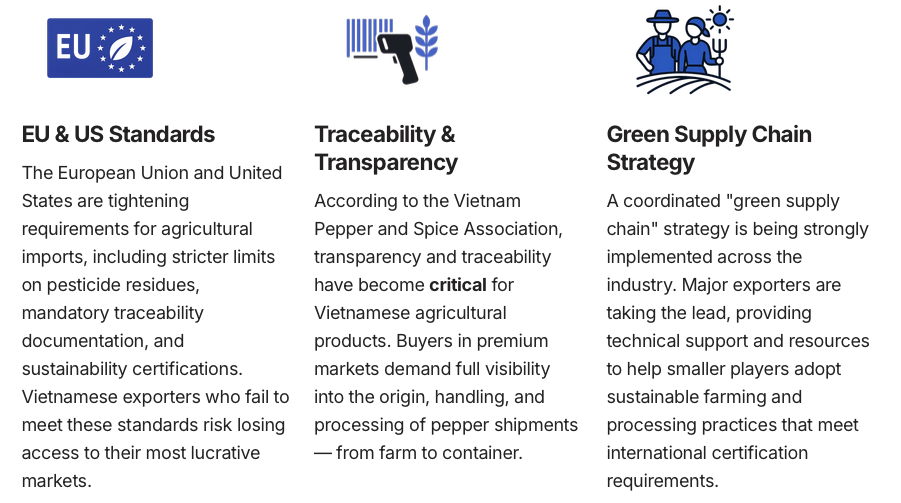
This transformation represents a fundamental shift in how Vietnam’s pepper industry competes globally. Rather than competing on price alone — where Brazilian and Indonesian competition is intense — the green transformation positions Vietnamese pepper as a premium, responsibly sourced product that commands higher margins and builds long-term buyer relationships in the world’s most demanding markets.
The Core Constraint
Despite the ambitious vision for Vietnam’s green pepper transformation, the industry faces three interconnected bottlenecks that threaten to slow progress. These challenges are well understood by industry leaders and the Vietnam Pepper and Spice Association, but resolving them requires coordinated action from government, financial institutions, and the private sector.
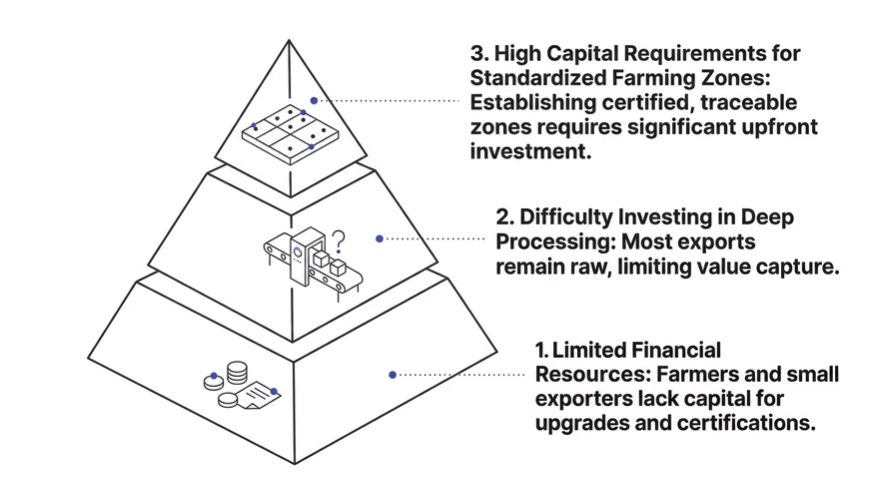
Limited financial resources represent the most immediate constraint. The majority of Vietnam’s pepper farmers operate on thin margins and lack access to the capital needed for certifications, upgraded equipment, or the transition to standardized farming practices. Without affordable financing, the green transformation risks becoming a project only for large exporters, leaving smallholder farmers behind.
Difficulty investing in deep processing is a structural challenge that has long limited Vietnam’s ability to capture value. The vast majority of Vietnamese pepper is exported as raw or minimally processed product, meaning the highest-margin segments — branded, packaged, value-added pepper products — are captured by importers and distributors in destination markets. Building domestic processing capacity requires significant capital investment and technical expertise that many operators currently lack.
High capital requirements for standardized farming zones present perhaps the most complex challenge. Establishing certified, traceable farming zones — with consistent quality controls, documented inputs, and verified sustainability practices — requires coordinated investment across entire producing regions. Individual farmers cannot achieve this alone; it requires cooperative structures, government support, and long-term commitment from export partners.