



2026 // Week 34 – Vietnam Pepper Market: 2026 Mid-Year Review
Domestic Market: Prices Hold Steady Amid Quiet Trading
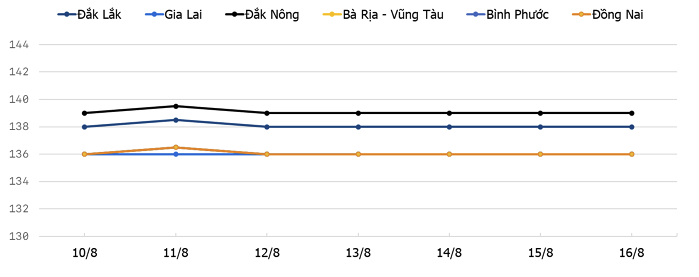
Pepper price trends in the Central Highlands and Southeast regions during the week from October 8th to August 16th, 2026
Domestic pepper prices in Vietnam remained remarkably stable through July 2026, holding within a narrow band of VND 136,000–139,000 per kilogram across the country’s major producing regions. The domestic market was characterized by subdued trading activity, with neither buyers nor sellers showing urgency to move significant volumes at current price levels. This stability reflects a market in equilibrium — domestic buyers are absorbing supply at a measured pace, while farmers and traders are holding firm on pricing expectations given the strong export backdrop.
The quiet domestic scene stands in sharp contrast to the vigorous export activity underway. With the majority of harvestable supply being channeled toward international contracts, domestic liquidity has tightened, yet this has not translated into upward price pressure. Market participants appear to be pricing in the broader global supply tightness, with domestic rates effectively anchored to export parity levels. Traders in the key producing provinces of Dak Lak, Gia Lai, and Ba Ria–Vung Tau reported steady order flow but limited speculative activity, suggesting confidence in the current price floor.
Export Performance: A Billion-Dollar Milestone
Vietnam’s pepper exports achieved a significant milestone during the first seven months of 2026, generating USD 1.087 billion in export revenue — officially surpassing the USD 1 billion mark for this period. According to the Vietnam Pepper and Spice Association (VPSA), the country exported 168,429 metric tons of pepper over this timeframe, representing a 16.1% increase in volume and a 10.1% increase in value compared with the same period in 2025. The divergence between volume growth and value growth suggests that while more pepper is moving through export channels, unit prices have moderated slightly — a dynamic partly attributable to product mix and destination market composition.
VPSA member companies demonstrated their dominant role in the export chain, accounting for 81.7% of total national pepper exports. This concentration underscores the importance of the association’s coordinated market access strategies, quality programs, and buyer relationships in driving sector-wide performance. The remaining share is handled by smaller independent exporters and trading houses, many of which serve niche or regional markets.
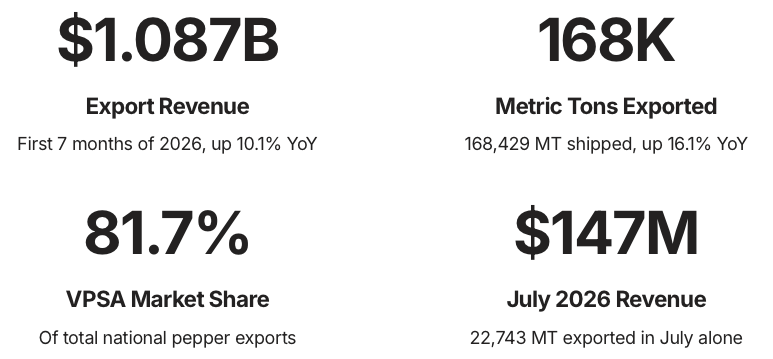
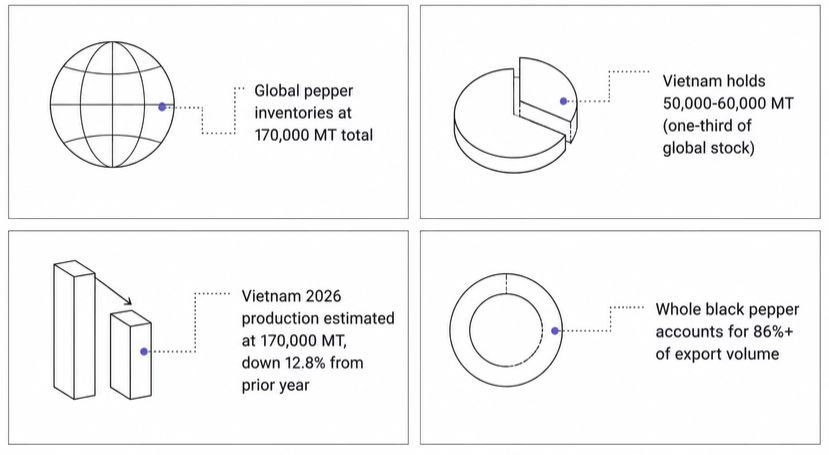
In July 2026 alone, Vietnam exported 22,743 metric tons of pepper worth USD 147.3 million. While export activity moderated slightly compared with the stronger June figures — a typical seasonal pattern as mid-year contracts are fulfilled — July volume was still 8.8% higher than July 2025, confirming the underlying strength of demand. Whole black pepper continued to dominate the export basket, accounting for more than 86% of total export volume, with the remainder comprising white pepper, ground pepper, and value-added pepper products. The continued dominance of whole black pepper reflects its broad applicability across foodservice, retail, and industrial processing channels in key destination markets.
Global Supply Tightness: Vietnam’s Strategic Advantage
The Global Inventory Picture
Global pepper inventories are currently estimated at just 170,000 metric tons — a critically tight level that is providing substantial support to international prices. Vietnam itself holds approximately 50,000–60,000 metric tons of this total, representing roughly one-third of all available global stock. This inventory position gives Vietnamese exporters meaningful leverage in contract negotiations, particularly as buyers in destination markets seek to secure supply ahead of potential further tightening.
The supply squeeze is being driven by production shortfalls across multiple producing countries, with adverse weather, disease pressure, and farmer switching to higher-value crops all contributing to reduced output. For Vietnam, this global backdrop creates a favorable pricing environment even as the country’s own production has declined year-over-year.
Vietnam’s 2026 Production Outlook
Vietnam’s domestic pepper production for 2026 is estimated at 170,000 metric tons, representing a 12.8% decline from the previous year. This contraction reflects ongoing challenges including aging pepper vines, reduced planting areas as farmers diversify into more profitable crops such as durian and coffee, and the cumulative impact of previous years’ low prices that discouraged investment in plantation maintenance.
Despite the production decline, the tighter supply environment is actually strengthening exporters’ bargaining power for second-half contracts. Buyers facing limited alternative sources are more willing to accept firm pricing and longer lead times. The main headwind remains elevated logistics costs, which continue to compress margins for exporters — particularly those serving distant markets where freight represents a larger share of landed cost.
Key Markets: US Demand Surges, EU Compliance Improves
United States: Strong Demand Drive
The United States emerged as a standout growth market for Vietnamese pepper during the first half of 2026. Export value to the US increased by 18.2% over the first six months of the year, outpacing overall export growth and reflecting robust consumer and foodservice demand. The US market’s appetite for Vietnamese pepper is being supported by growing interest in ethnic cuisines, expansion of the foodservice sector, and the product’s competitive positioning against peppers from other origins. This strong performance underscores the importance of the US as a premium destination market for Vietnamese exporters seeking value over volume.
European Union: Compliance Gains
Vietnam’s pepper sector made meaningful progress in EU market access compliance during 2026. The number of Vietnamese pepper shipments violating maximum residue limits (MRLs) fell from five cases to just three, a significant improvement that has tangible commercial implications. As a direct result, Vietnam’s spice sector has been removed from the EU’s top five product categories receiving the most food safety alerts — a notable reputational milestone that should facilitate smoother customs clearance and reduce inspection frequency for compliant exporters. This improvement reflects growing investment in farm-level quality management and pre-export testing protocols.
Industry Focus: Quality Control as Competitive Moat
Despite the overall improvement, pesticide residues remain the single largest compliance challenge for Vietnamese pepper exporters targeting the EU, accounting for approximately half of all EU warning cases involving Vietnamese spices. This concentration of risk highlights the need for continued investment in integrated pest management, farmer training, and pre-shipment testing infrastructure. Exporters who can demonstrate robust residue control systems will be best positioned to capture the premium that EU buyers are willing to pay for compliant, reliably sourced pepper.
As Vietnam’s pepper sector navigates the second half of 2026, the industry faces a dual imperative: capitalize on the favorable global supply environment while simultaneously addressing the quality and compliance challenges that could limit long-term market access. Industry experts are increasingly clear that the path to sustained competitiveness runs through farm-level quality control rather than reliance on final inspections before packaging.