


2026 // Week 40 – Vietnam Pepper Market Update: Stable Across All Regions
Domestic Price Survey: Stable Across All Regions
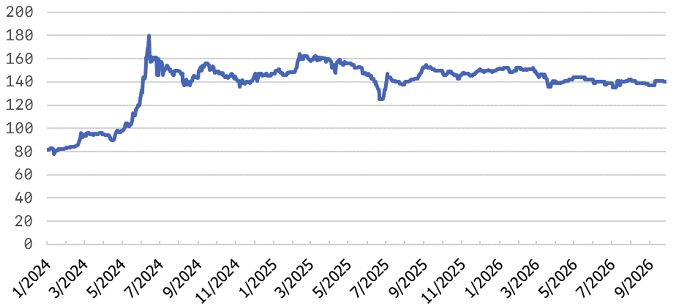 Pepper price developments in the Central Highlands and Southeast from First 2023 to 28-September, 2026 (Unit: VND/kg)
This morning’s survey confirmed that pepper prices across Vietnam’s key producing provinces remained completely unchanged from the previous trading session. The domestic reference price for black pepper held at approximately VND 139,000/kg, with regional farm-gate prices ranging between VND 136,000 and VND 140,000/kg. The absence of price movement reflects a market in a consolidation phase — neither buyers nor sellers are under pressure to move, as holiday-related slowdowns on the demand side are matched by limited selling urgency on the supply side.
Đắk Nông (Lâm Đồng Province) continued to lead domestic pricing at VND 140,000/kg, maintaining its position as the highest-priced producing region. Đắk Lắk followed at VND 138,000/kg, while Bà Rịa-Vũng Tàu (Ho Chi Minh City reference) traded at VND 136,500/kg. Gia Lai and Đồng Nai both held at VND 136,000/kg, representing the floor of the current domestic price range. The narrow VND 4,000/kg spread between the highest and lowest regions indicates a well-integrated domestic market with efficient price discovery.
The stability in domestic prices, despite the temporary lull in Chinese purchasing, suggests that Vietnamese growers and traders are not facing inventory pressure. With Chinese importers expected to resume buying in early October to build Q4 inventories, domestic prices are likely to find support in the coming weeks. The current consolidation phase may represent a pause before the next directional move, particularly as global supply fundamentals tighten and export demand rebuilds post-holiday.
Global Pepper Prices: International Benchmarks Hold Steady
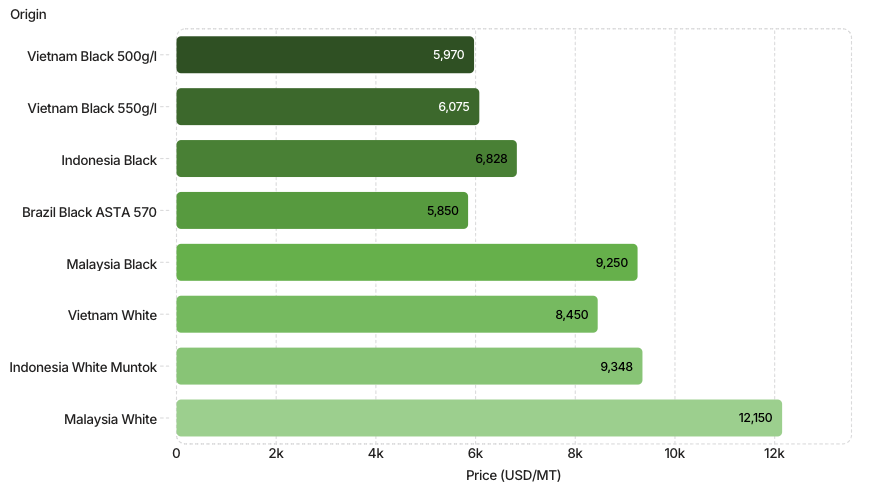
At the close of the latest trading session, global pepper prices showed no new movements, with all major origin benchmarks reported unchanged by the International Pepper Community (IPC). Indonesia’s black pepper held at USD 6,828/MT, while Brazil’s ASTA 570 black pepper was quoted at USD 5,850/MT. Malaysia’s black pepper, the premium benchmark, remained at USD 9,250/MT. The stability across all origins suggests that global supply-demand dynamics are currently in equilibrium, though the underlying tightness in global pepper supply noted by market participants could introduce upward pressure once Chinese buying resumes.
Vietnam’s export prices for black pepper were quoted at USD 5,970/MT for 500 g/l density and USD 6,075/MT for 550 g/l density — both unchanged from the previous session. These prices position Vietnam competitively against Brazil’s USD 5,850/MT while offering a meaningful discount to Indonesia’s USD 6,828/MT and Malaysia’s USD 9,250/MT. The USD 105/MT premium for higher-density 550 g/l pepper reflects the market’s recognition of quality differentiation and the value that denser pepper commands in end-user applications.
On the white pepper side, all prices also remained unchanged. Indonesia’s Muntok white pepper held at USD 9,348/MT, Malaysia’s white pepper at USD 12,150/MT, and Vietnam’s white pepper at USD 8,450/MT. Vietnam’s white pepper trades at a notable discount to both Indonesia and Malaysia, which may present an opportunity for buyers seeking cost-effective white pepper alternatives. The wide spread between Malaysia’s USD 12,150/MT and Vietnam’s USD 8,450/MT — a difference of USD 3,700/MT — underscores the premium that Malaysian white pepper commands in the market, while Vietnam’s pricing offers an attractive entry point for price-sensitive buyers.
Vietnam Export Performance: Strong Volume Growth Continues
Vietnam’s pepper export performance in 2026 has been robust, with the first eight months delivering 190,153 metric tons — a 14.2% increase compared to the same period in 2025. This volume growth underscores the resilience of Vietnam’s pepper sector despite global macroeconomic headwinds and demonstrates the country’s ability to capture market share across multiple destinations. The United States remained Vietnam’s largest export market, absorbing 44,349 metric tons during this period — a testament to sustained American demand for Vietnamese pepper and the strength of established trade relationships.
The first 15 days of September alone saw Vietnam export 10,915 metric tons valued at approximately USD 70 million, representing a strong pace that contributed meaningfully to the year-to-date total. Export growth was particularly pronounced to two key markets: the United States surged 62.4% year-over-year, while China posted a 34.1% increase. China’s pepper purchases have already exceeded its total imports for the full year of 2025, highlighting the scale of Chinese demand recovery and the importance of this market for Vietnamese exporters.
The combination of strong U.S. demand and rapidly growing Chinese purchases suggests that Vietnam’s export outlook for the remainder of 2026 remains positive. With Chinese importers expected to resume inventory-building in early October following the holiday period, and U.S. demand showing no signs of weakening, Vietnam’s pepper exporters are well-positioned to sustain the double-digit volume growth trajectory through the fourth quarter. The key risk factors to monitor include freight cost volatility, regulatory compliance requirements, and the potential impact of higher interest rates on buyer purchasing behavior.
China Demand: Temporary Pause Before Q4 Rebound
Chinese pepper purchasing activity has temporarily slowed as importers observe the Mid-Autumn Festival and National Day holidays — collectively known as China’s “Golden Week.” This seasonal pause is a well-understood pattern in the pepper trade, and market participants are not interpreting the slowdown as a sign of weakening underlying demand. On the contrary, China’s pepper purchases have already surpassed the country’s total import volume for the entire year of 2025, demonstrating the exceptional scale of Chinese demand recovery in 2026.
The expectation among Vietnamese exporters is that Chinese buying will pick up significantly in early October as importers return to the market to build inventories for the fourth quarter. Q4 is traditionally a strong period for Chinese pepper imports, driven by holiday-season food manufacturing demand and year-end inventory positioning. With China’s purchases already exceeding 2025’s full-year total, the potential for further inventory building in Q4 could create meaningful competition for available supplies and provide upward support for both domestic and export prices.
However, exporters should be aware of evolving regulatory requirements at the China border. Customs clearance for pepper exports through the Hekou border gate has been delayed by 1–2 days due to stricter aflatoxin inspection requirements. These delays add to logistics costs and extend delivery timelines, factors that exporters must account for in their pricing and contract terms. The combination of stronger inspection protocols and the potential for renewed buying pressure in October suggests that Chinese market access will remain a critical variable for Vietnamese pepper exporters in the coming weeks.
Macroeconomic & Regulatory Headwinds
The U.S. Federal Reserve resumed its interest rate tightening cycle on September 16, raising its policy rate by 25 basis points to a target range of 3.75%–4.00% as inflation remained persistent. This development has direct implications for pepper trade financing. Higher borrowing costs make buyers in many markets more cautious about replenishing inventories, and may lead them to request longer payment terms from suppliers. For Vietnamese exporters, this could mean increased working capital requirements and potentially higher overall costs associated with pepper exports, particularly for transactions denominated in U.S. dollars.
On the regulatory front, food safety compliance continues to reshape market access conditions for pepper exporters. The U.S. Food and Drug Administration (FDA) has detained pepper shipments after detecting Salmonella contamination, underscoring the growing importance of certified steam sterilization processes. Exporters without verified sterilization protocols face increasing risk of shipment rejections, which can result in significant financial losses and damage to buyer relationships. Investment in FDA-compliant processing infrastructure is increasingly becoming a prerequisite for maintaining access to the U.S. market — Vietnam’s largest export destination.
In India, market participants reported that discussions regarding a Minimum Import Price (MIP) of INR 500/kg — although not yet officially confirmed — have reportedly reduced pepper export volumes to the country. If implemented, such a policy could redirect Indian demand toward alternative origins or reduce overall import volumes, with implications for global supply-demand balances. Exporters with Indian market exposure should monitor this development closely and consider diversification strategies if the MIP is formally enacted.
Weather Outlook & Freight Rate Movements
Vietnam’s Central Highlands experienced normal seasonal rainfall during the past week, providing favorable conditions for current fruit development and flowering for the 2027 pepper crop. This is a welcome contrast to the severe disruptions caused by Typhoons Ragasa and Bualoi in late September 2025, which caused significant damage to pepper-growing areas. The absence of extreme weather events this season is a positive signal for the upcoming crop, though market participants will continue to monitor weather patterns through the remainder of the growing season. A healthy 2027 crop outlook could help stabilize longer-term supply expectations, though the current tightness in global pepper supply remains a near-term supportive factor for prices.
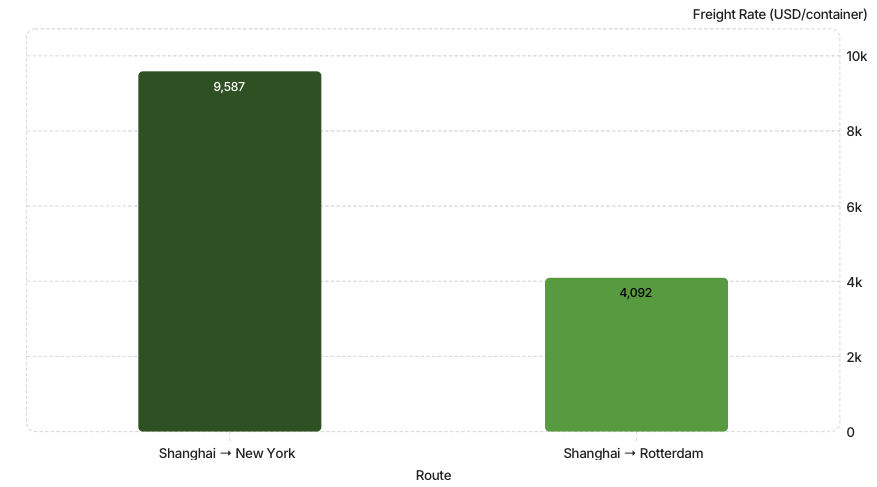
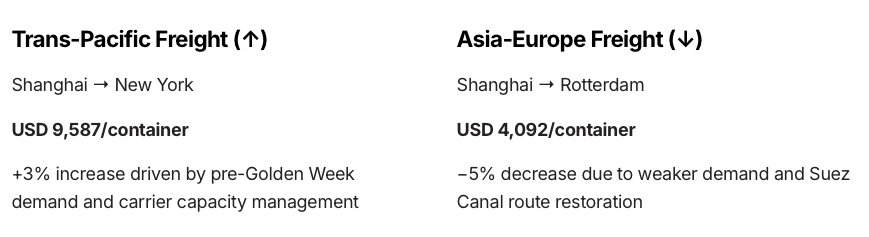
On the freight side, the market showed divergent trends across major trade lanes. Pre-holiday demand ahead of China’s Golden Week, combined with carrier capacity management, pushed Trans-Pacific container freight rates higher. Freight from Shanghai to New York increased 3% to USD 9,587 per container, adding to the cost burden for U.S.-bound pepper shipments. This increase comes at a time when U.S. demand for Vietnamese pepper is surging — up 62.4% year-over-year — meaning that a larger share of Vietnam’s export volume will be affected by these higher Trans-Pacific rates.
Conversely, Asia-Europe freight rates continued to decline due to weaker demand and the gradual restoration of shipping routes through the Suez Canal. Freight from Shanghai to Rotterdam fell 5% to USD 4,092 per container, offering some relief for European-bound shipments. The divergence between Trans-Pacific and Asia-Europe rates reflects the uneven recovery in global trade flows and the varying impact of China’s holiday season on different trade lanes. Exporters serving European markets may benefit from the declining rate environment, while those focused on the U.S. market should factor the higher Trans-Pacific rates into their pricing and margin calculations.