



2026 // Week 24 – Vietnam Pepper Market Update: Vietnam Continues Buying Large Volumes of Brazilian Pepper
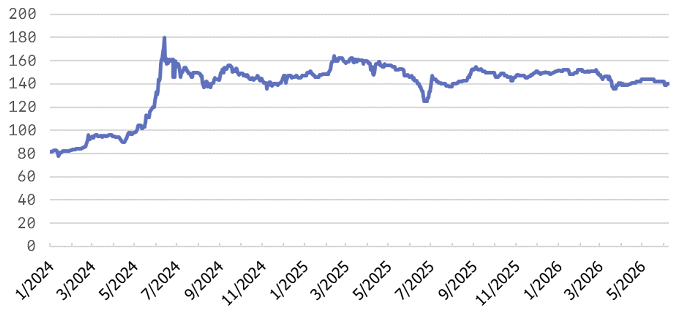
Pepper price developments in the Central Highlands and Southeast from First 2023 to 08-June, 2026 (Unit: VND/kg)
Despite a notable slowdown in monthly volumes, Vietnam retained its position as Brazil’s top pepper buyer through the first five months of 2026. Domestic Vietnamese prices held firm at VND 137,000–140,000/kg, signaling sustained underlying demand even as import patterns shifted. Brazil’s overall export performance remained positive year-on-year, buoyed by growth from emerging markets that partially offset softening demand from traditional destinations.
Vietnam’s Import Profile: Dominant but Declining
Vietnam’s role as Brazil’s largest pepper customer remained unchallenged through May 2026, but the data reveals a clear softening in purchasing momentum. Over the first five months of 2026, Vietnamese companies imported 14,350 tonnes of Brazilian pepper, representing 30.2% of Brazil’s total pepper exports — a commanding share that underscores Vietnam’s structural dependence on Brazilian supply. However, this cumulative volume was down 14.4% compared with the same period in 2025, pointing to a meaningful year-on-year contraction in Vietnamese procurement.
May 2026 alone illustrated the depth of the slowdown. Vietnam imported just 3,036 tonnes from Brazil in May, representing 33.2% of total Brazilian exports for the month. This was a sharp 36.9% decline from April and a 6.6% drop compared with May 2025. The sequential contraction was particularly pronounced, suggesting that Vietnamese buyers may have been working through existing inventories or responding to elevated domestic price levels that made new purchases less attractive at current Brazilian export prices.
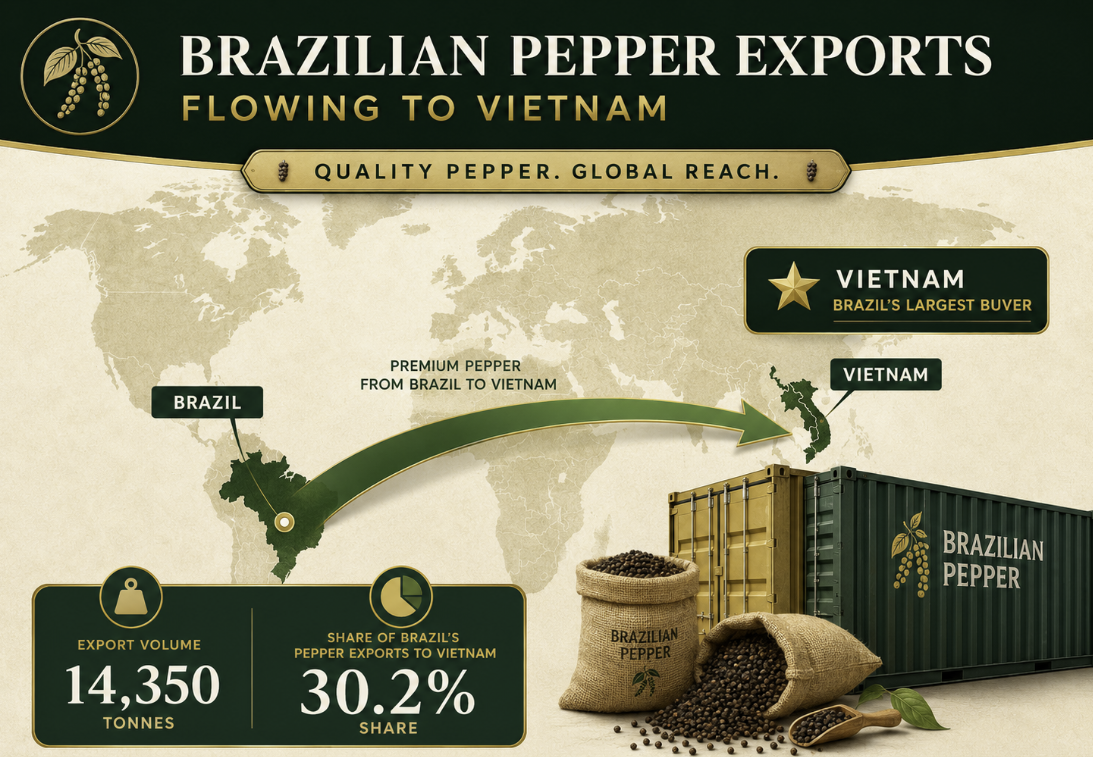
The divergence between Vietnam’s sustained market share and its declining absolute volumes is a key signal for traders. Vietnam’s dominance is not in question, but the pace of its buying has moderated significantly — a trend that could have implications for Brazilian export planning and pricing strategy in the second half of 2026.
May 2026: Brazil’s Pepper Exports Contract Sharply
May 2026 was a challenging month for Brazilian pepper exporters across the board. Total exports fell to 9,137 tonnes worth USD 56 million, representing declines of 28.3% in volume and 28.8% in value compared with April 2026. The sequential drop was broad-based, affecting nearly all major destination markets and pointing to a systemic slowdown in global pepper procurement rather than a Vietnam-specific phenomenon.
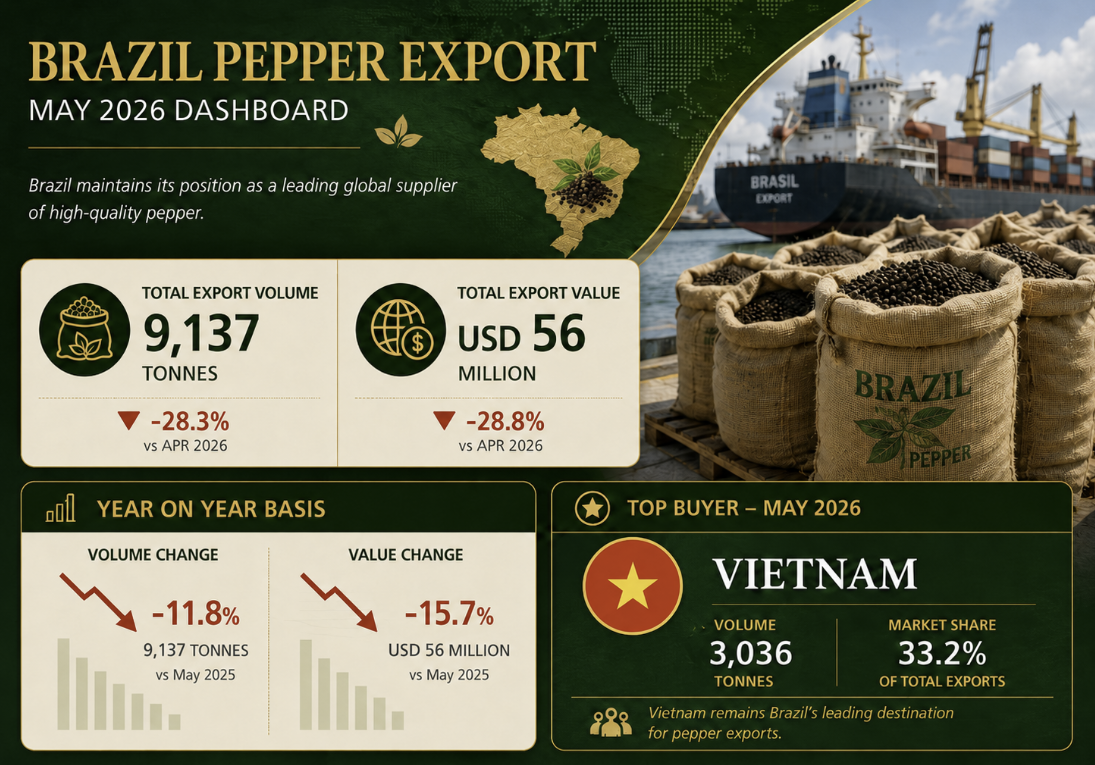
On a year-on-year basis, May 2026 exports were also weaker — down 11.8% in volume and 15.7% in value compared with May 2025. The dual sequential and year-on-year contraction suggests that the slowdown reflects broader demand dynamics rather than seasonal or one-off factors. For traders, the key question is whether this represents a temporary pause in purchasing cycles or a more sustained shift in global pepper demand patterns as buyers respond to elevated price levels across origin markets.
Global Demand: Mixed Signals Across Key Markets
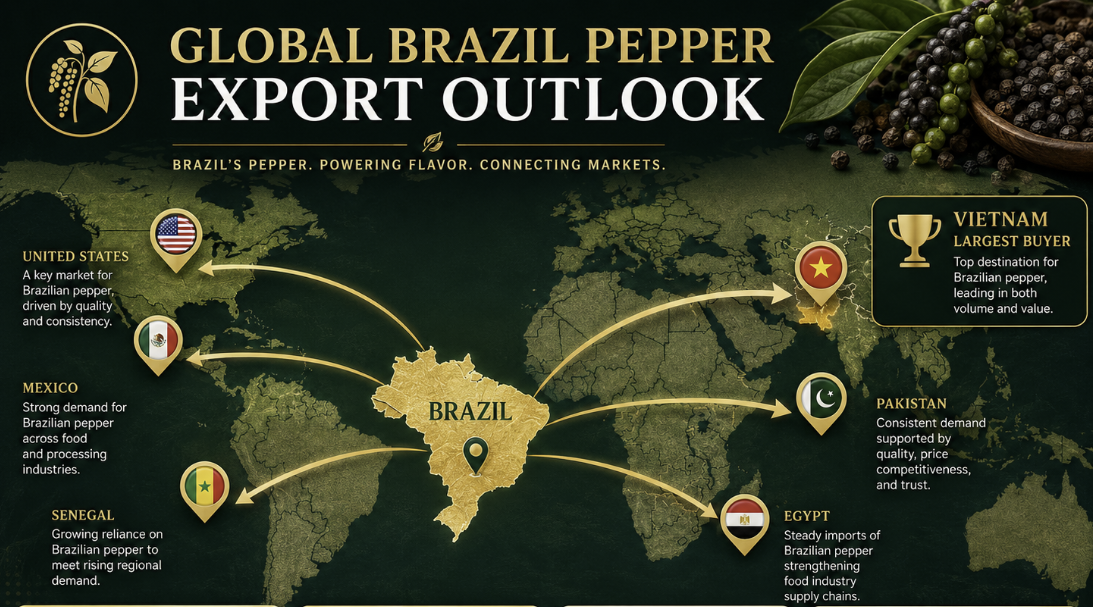
The May 2026 slowdown was not confined to Vietnam. A broad swath of traditional importing markets showed weakened demand, suggesting a wider recalibration of purchasing behavior across the global pepper trade. Pakistan, India, Germany, the Netherlands, and the UAE all recorded lower import volumes compared with April, reflecting a synchronized pullback from both Asian and European buyers. This pattern points to elevated price sensitivity across multiple regions, as buyers appear to be rationing purchases in response to sustained high prices at origin.
Markets Showing Weakness
Pakistan, India, Germany, the Netherlands, and the UAE all reduced imports in May 2026 compared with April. The breadth of this decline — spanning South Asia, Europe, and the Middle East — suggests that elevated prices are dampening demand across diverse buyer profiles, not just in a single region.
Markets Showing Growth
Senegal and Egypt stood out as bright spots, increasing imports by 16.4% and 9.1% respectively compared with April. These West and North African markets demonstrated resilience even as larger traditional buyers pulled back, potentially reflecting different procurement cycles or growing domestic consumption demand.
The divergence between weakening traditional markets and growing African destinations is noteworthy for long-term trade strategy. Senegal’s 16.4% month-on-month increase and Egypt’s 9.1% gain suggest that demand growth is shifting geographically, with emerging African markets beginning to play a more meaningful role in absorbing Brazilian pepper supply. For exporters and traders, monitoring these emerging destinations could provide early signals of where incremental demand growth is likely to materialize in the latter half of 2026 and beyond.
Five-Month Outlook: Brazil’s Exports Up Despite Monthly Volatility
Despite the May slowdown, Brazil’s pepper export performance for the first five months of 2026 remains solidly positive. Cumulative exports reached 47,480 tonnes worth USD 294.7 million, up 7.9% in volume and 8.3% in value year-on-year. This growth was underpinned by stronger demand from a diverse set of emerging markets — including the United States, Mexico, Senegal, Pakistan, and Egypt — which collectively helped offset the softening from traditional destinations.
The year-on-year growth in both volume and value confirms that Brazil’s pepper export sector is on a healthy trajectory despite short-term monthly volatility. The contribution from the United States and Mexico is particularly significant, as North American demand has historically been less prominent in Brazil’s pepper export profile. Their emergence as growth contributors suggests that Brazilian pepper is gaining traction in markets that may have previously sourced from other origins, potentially reflecting competitive pricing or quality perceptions.