



2026 // Week 22 – Vietnam Pepper Market: Export Surge in 2026
Domestic Prices & Export Performance: Strong Growth Across All Metrics
Domestic black pepper prices have remained stable at high levels at 140-142k VND, providing a supportive foundation for export competitiveness. The combination of robust volume growth and sustained pricing strength signals strong international demand, even as global supply chains navigate ongoing disruptions and elevated logistics costs. For trade stakeholders and export managers, these results validate the strategic direction pursued by Vietnamese producers and reinforce confidence in the sector’s capacity to scale.
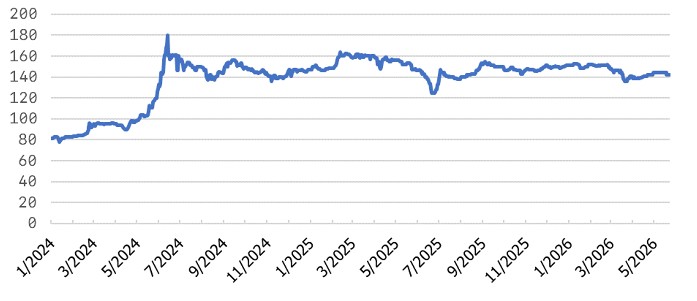
Pepper price developments in the Central Highlands and Southeast from First 2023 to 25-May, 2026 (Unit: VND/kg)
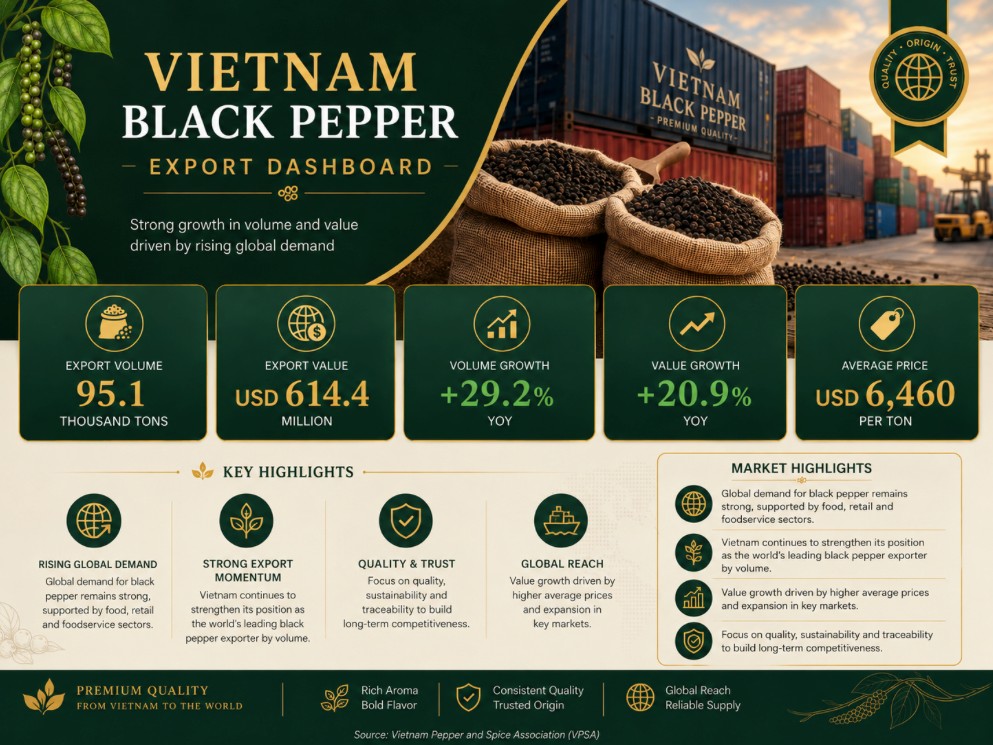
According to the latest statistics released by Vietnamese trade authorities, the country exported 95.1 thousand tons of pepper during the first four months of 2026, generating USD 614.4 million in export revenue. These figures represent a significant year-on-year improvement across both volume and value dimensions, underscoring the resilience and competitiveness of Vietnam’s pepper industry on international markets.
Compared with the same period in 2025, export volume increased by 29.2%, while export value rose by 20.9%. Although the average export price adjusted slightly lower to approximately USD 6,460 per ton, black pepper remained the undisputed leading growth driver within Vietnam’s broader spice export sector. The slight price moderation reflects normalization from elevated 2025 levels rather than weakening demand, and the sector’s ability to grow value at near-parity with volume confirms strong underlying market fundamentals.
Market Outlook: Two Scenarios for 2026
The Vietnam Pepper and Spice Association (VPSA) has outlined two distinct development scenarios for the remainder of 2026, each contingent on the trajectory of global geopolitical developments — particularly tensions in the Middle East, which directly affect shipping routes and supply availability in key export corridors.
Scenario A: Continued Geopolitical Tensions
If Middle East tensions persist and affect approximately 15% of export flows in the region, global pepper prices are expected to remain elevated due to supply shortages. Under this scenario, Vietnam’s pepper export value could still grow by 5–10%, supported by higher unit prices even if volume growth moderates. Importers facing disrupted supply chains from other origins will increasingly turn to Vietnam as a reliable alternative source.
Scenario B: Geopolitical De-escalation
If geopolitical tensions ease and trade flows normalize, the pepper sector could pursue double-digit growth in both volume and value. Recovering demand from major markets — including the United States, China, and Germany — would provide the primary tailwind. Lower freight costs and improved logistics efficiency would further enhance Vietnam’s competitiveness and margin profile for exporters.
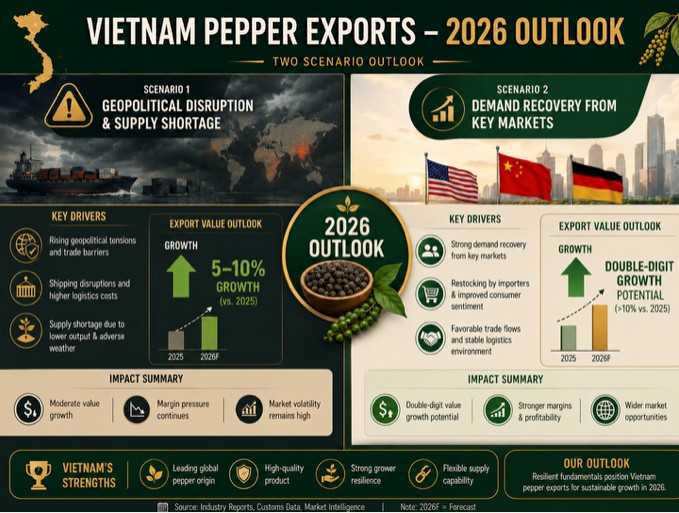
Both scenarios point to positive outcomes for Vietnam’s pepper sector, though the magnitude of growth differs considerably. VPSA representatives have emphasized that regardless of which scenario materializes, the sector’s strategic focus must remain on quality, compliance, and value-added processing rather than pure volume expansion. The ability to adapt to either environment — and to pivot quickly as conditions change — will be a critical differentiator for Vietnamese exporters in 2026 and beyond.
Regulatory Headwinds: Compliance Is No Longer Optional
While the export outlook remains broadly positive, Vietnam’s pepper sector faces mounting pressure from importing countries that are progressively tightening their regulatory frameworks. These evolving requirements represent both a challenge and an opportunity — companies that invest in compliance now will be best positioned to capture premium market access as standards rise globally.
Pesticide Residue Limits
Importing countries are enforcing increasingly stringent maximum residue levels (MRLs) for pesticide content in pepper shipments. Non-compliant consignments face rejection, detention, or destruction at ports of entry, resulting in direct financial losses and reputational damage for exporters. Proactive testing and integrated pest management are becoming baseline requirements.
Traceability Transparency
Major markets, particularly the EU and the United States, are demanding end-to-end traceability from farm to shipment. Exporters must be able to document the origin of raw materials, processing conditions, and quality control measures. Digital traceability systems and cooperative-level record-keeping are becoming essential infrastructure for market access.
Quality Compliance Standards
Phytosanitary regulations are expected to tighten further during mid-2026, with major importing markets introducing new requirements for microbial limits, moisture content, and foreign matter thresholds. Domestic companies must proactively cooperate with cooperatives and regulators to align production practices with these emerging standards before they become enforceable.
The Strategic Imperative: From Volume to Value
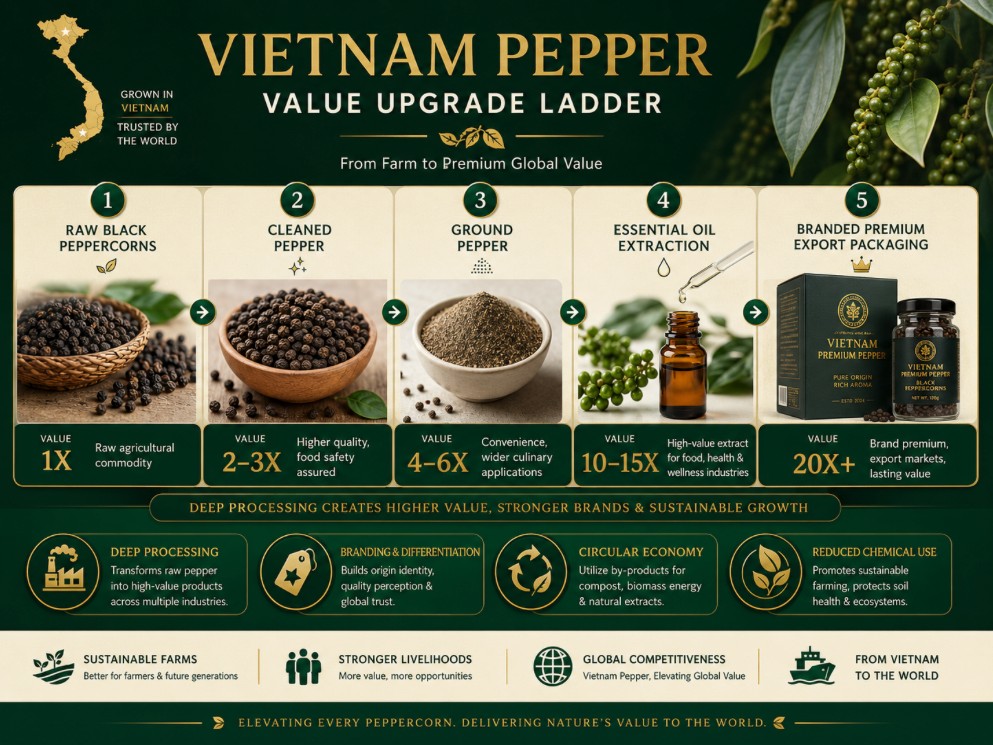
VPSA representatives have been unequivocal: pure volume expansion has reached its limit. The era of competing on tonnage alone is over. The only sustainable path to increasing industry value — and protecting Vietnam’s dominant market position — lies in moving up the value chain through deeper processing, product diversification, and brand building. This strategic pivot is not optional; it is an existential necessity for the sector’s long-term competitiveness.
Deeper Processing Technology
Invest in grinding, sterilization, and packaging infrastructure to export higher-margin processed products rather than raw commodity pepper.
Essential Oil Extraction
Develop capacity for pepper essential oil production, which commands significantly higher unit prices and serves the food, pharmaceutical, and cosmetic industries.
Stronger Branding
Build recognizable Vietnamese pepper brands with geographic indication protection, quality certifications, and consumer-facing storytelling to capture premium positioning.
Green Production as Market Entry Requirement
Green production practices, reduced chemical use, and circular-economy models are no longer aspirational — they are now considered mandatory entry requirements for participation in global markets. Buyers in the EU, United States, and other premium markets are embedding sustainability criteria directly into procurement specifications and supplier qualification processes.
Vietnamese producers must accelerate adoption of:
- Integrated pest management and biological control methods
- Organic and near-organic cultivation practices
- Water and energy efficiency in processing facilities
- Circular-economy models that utilize pepper by-products
- Clean raw-material zones coordinated at the cooperative level
Enabling the Transition: Financing, Cooperation & Policy
Realizing Vietnam’s pepper sector ambitions — from commodity exporter to value-chain leader — requires coordinated action across financing, industry cooperation, and regulatory engagement. The transition cannot be achieved by individual companies alone; it demands systemic support structures that enable small and medium-sized enterprises (SMEs) to participate in the upgrade trajectory.
Preferential Financing Access
To facilitate exports and accelerate deep processing investment, the pepper sector requires improved access to preferential financing, particularly for SMEs that lack the collateral or credit history to secure commercial loans at viable rates. Policy interventions could include government-backed loan guarantees, dedicated agri-processing credit lines, and export financing facilities tailored to the seasonal cash-flow dynamics of pepper production and trade.
Cooperative-Led Raw Material Zones
Domestic companies must proactively cooperate with agricultural cooperatives to develop clean raw-material zones — geographically defined production areas where standardized farming practices, input controls, and quality monitoring are implemented collectively. These zones serve as the foundation for traceability systems and provide buyers with the supply assurance needed to commit to long-term contracts at premium prices.
Regulatory Coordination
Close coordination between industry participants and regulatory bodies is essential to avoid disruptions in trade flows as new phytosanitary regulations take effect in mid-2026. Early engagement with importing-country authorities, participation in international standards-setting processes, and investment in domestic testing and certification infrastructure will position Vietnamese exporters to meet new requirements before they become enforcement barriers.
The only sustainable path to increasing industry value lies in deeper processing technology, essential oil extraction, and stronger branding. Green production and circular-economy models are now mandatory entry requirements for global markets.
— Vietnam Pepper and Spice Association (VPSA)