



2026 // Week 44 – Vietnam Pepper Market Update: Q3 2026 Review and Outlook
Domestic prices held steady
Prices were unchanged today across major producing provinces, holding at VND 137,000–139,500/kg.
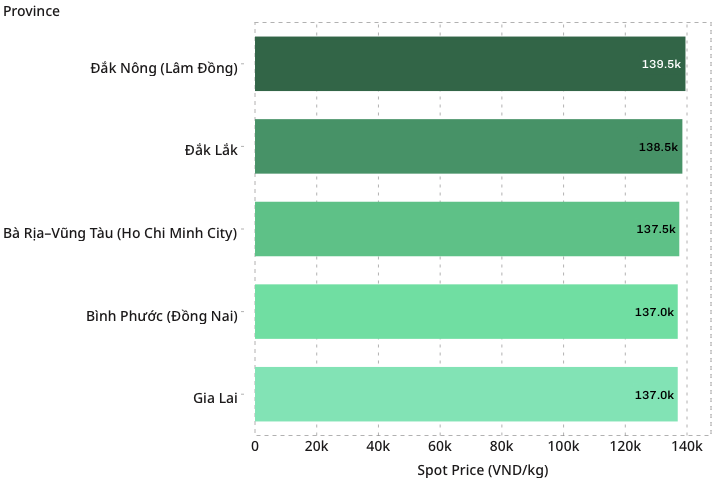
Provincial Spot Price Comparison – VND/kg
Đắk Nông (Lâm Đồng) was highest at VND 139,500; Đắk Lắk at VND 138,500; Bà Rịa–Vũng Tàu (Ho Chi Minh City) at VND 137,500; Gia Lai and Bình Phước (Đồng Nai) lowest at VND 137,000.
VPSA expects prices to keep fluctuating within a relatively stable range in the short to medium term.
Global prices: Indonesia rises while other origins stay flat
Indonesian black and Muntok white pepper rose; the listed Malaysia, Vietnam and Brazil benchmarks were unchanged.
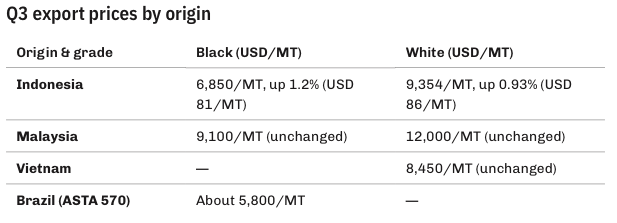
Comparative FOB export prices across primary producing countries at the end of Q3 2026.
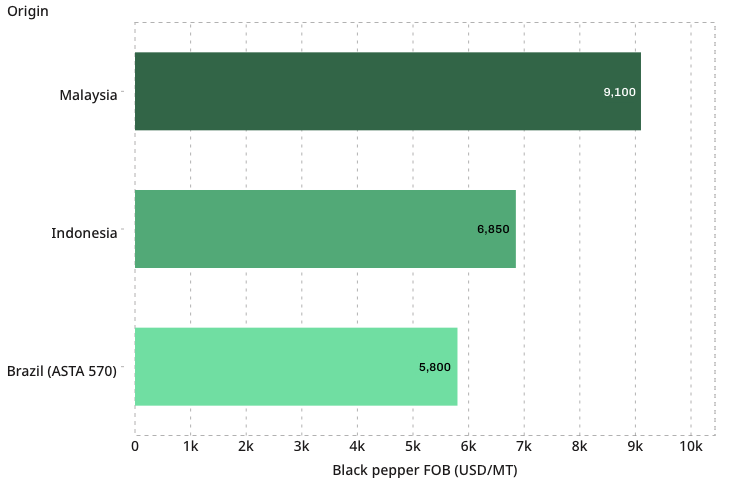
Global Black Pepper FOB Export parity (USD/MT).
Why prices did not rise in Q3 despite a short 2026 crop
The 2026 harvest ended below 2025, with low inventories, so year-end gains wereexpected.
Counterweights capped prices
Middle East conflict, a strong Brazilian crop and large Cambodian releases capped prices.
Rain disrupted post-harvest practice
Uneven rainfall disrupted post-harvest practice. Persistent rain in September and early October affected fruit setting for the 2027 crop.
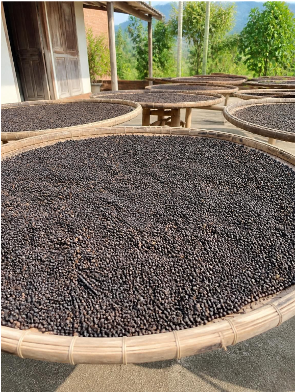
Post-harvest sun-drying of raw peppercorns on farm drying patios.
Q3 2026: domestic and export prices both fell YoY
Quarterly comparisons confirm softening across all domestic farmgate benchmarks and FOB export contracts relative to both previous 2026 quarters and Q3 2025. Comprehensive price data across the third quarter reveals broad contractions. Although domestic prices registered modest intra-quarter recoveries from July troughs, overall quarterly averages retreated noticeably across both raw and export markets.
Domestic Black Pepper (Avg. VND 137,333/kg)
Contracted 1.7% vs Q2, 6.6% vs Q1, and down 5.3% (a drop of VND 7,667/kg) compared to Q3 2025. Prices rebounded slightly from VND 136,000/kg in July to VND 138,000/kg in September.
Domestic White Pepper (Avg. VND 217,667/kg)
Fell 2.1% vs Q2, 8.2% vs Q1, and declined 7.5% year on year. Farmgate values edged up from VND 215,000/kg in July to VND 219,000/kg at quarter end.
Export Black Pepper (Avg. USD 6,205/MT)
Slipped 2.0% vs Q2, 5.0% vs Q1, and fell 3.2% year on year, easing progressively from USD 6,266/MT in July down to USD 6,164/MT in September.
Export White Pepper (Avg. USD 8,081/MT)
Down 3.0% vs Q2, 6.2% vs Q1, and fell 5.7% year on year. After rallying from USD 8,059/MT in July to USD 8,243/MT in August, values softened to USD 7,942/MT in September.
Q3 Price Contractions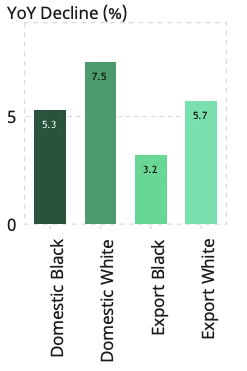
Percentage decreases recorded across domestic and export categories comparing Q3 2026 to prior periods.
Domestic recoveries in late September failed to overcome the quarterly deficit established during June–July sell-offs.
Q4 outlook: demand from the US and China decides the direction
In Q4 2026, export dynamics are at a critical equilibrium: global spice processors need pipeline replenishment for holiday and industrial processing cycles, while high ocean carrier rates distort delivered parity. EU demand is forecast lower than last year, reducing Western competition and focusing suppliers on North American and Chinese commitments. Muted EU intake and active Brazilian exporters leave trade flows into the two largest destination economies to determine Q4 price action.
BULLISH SCENARIO · DEMAND EXPANSION / UPSIDE FORCES
US Restocking Rebound. American retail and food service processors increase spot commitments to rebuild depleted inventories ahead of calendar year-end renewals.
Chinese Border Demand. Chinese traders step up cross-border and maritime purchases, absorbing Vietnamese black pepper stocks as domestic stocks deplete.
Freight Support Threshold. Higher logistics and handling costs establish a firm price floor, compelling international buyers to accept firmer FOB offers.
BEARISH SCENARIO · COMPETITIVE SATURATION / DOWNSIDE FORCES
Brazilian Crop Pressure. New-crop arrivals from Brazil enter export lanes aggressively, intensifying price competition in price-sensitive destination markets.
Hand-to-Mouth Procurement. Buyers delay bulk forward contracts, preferring small, frequent consignments to minimize capital exposure under elevated freight rates.
Soft European Intake. Sluggish economic conditions and strict regulatory scrutiny across the EU curb import volumes below previous-year benchmarks; EU import volumes are forecast below last year’s.
Outlook: 2027 crop and Middle East logistics are the main risks
2027 crop
If El Niño develops from late 2026, heat and rainfall shortages could hit flowering and fruit development in Vietnam, Indonesia and northern Brazil; severity and duration decide the impact.
Widespread, prolonged bad weather could cut yields and push prices up.
Middle East logistics
Middle East instability could alter routes, lengthen delivery and raise logistics costs; higher freight can lift delivered prices but also make buyers cautious.
Industry Priorities
Align buying with commitments: Tie raw-material buying to order schedules, production needs and financial capacity, holding enough stock to meet deliveries.
Diversify supply and monitor quality: Diversify supply, control quality at intake and monitor crops in major producing countries.
Price for changing conditions: Price offers and long-term contracts for raw-material, exchange-rate, freight and timing swings, and consider price-adjustment clauses.
Stay flexible: VPSA: flexible procurement and contract management will keep businesses better prepared for volatility.