



2026 // Week 32 – Vietnam Pepper Export Report: EU Market Analysis 2026
Domestic Price Stability: A Foundation for Export Competitiveness
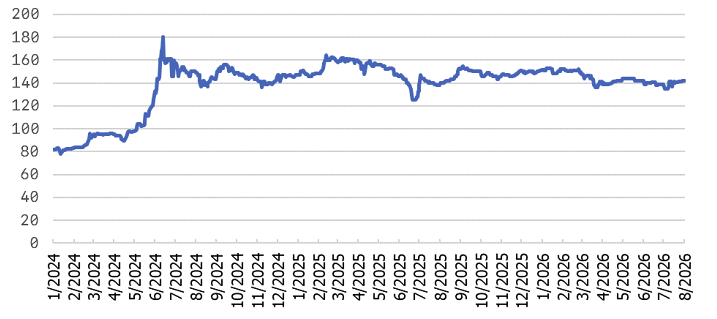
Pepper price developments in the Central Highlands and Southeast from First 2023 to 03-August, 2026 (Unit: VND/kg)
On today’s trading session, domestic pepper prices in Vietnam held steady, with no significant movement recorded across major growing regions. Prices remained within a tight corridor of VND 138,000 to VND 141,000 per kilogram, reflecting a well-balanced supply-demand dynamic at the farm and wholesale levels. This price stability is a critical signal for exporters planning forward contracts and negotiating with European buyers who increasingly demand predictable pricing structures to support their inventory planning.
The unchanged price environment suggests that domestic supply is meeting demand without significant pressure from either side. For exporters, this stability provides a reliable cost base when structuring export deals, reducing the risk of margin erosion between contract signing and shipment. It also signals to European importers that Vietnamese supply chains remain consistent and dependable — a key differentiator in a market where reliability often outweighs marginal price advantages.
EU Pepper Imports: A Market Under Pressure in Early 2026
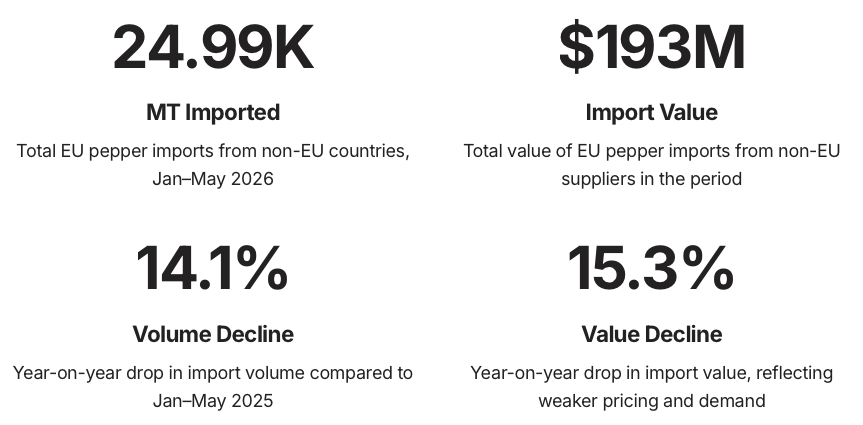
According to Eurostat data compiled by Vietnam’s Agency of Foreign Trade under the Ministry of Industry and Trade, EU member states imported a total of 24,990 metric tons of pepper worth USD 193.28 million from non-EU countries during the first five months of 2026. These figures represent a notable contraction compared to the same period in 2025, with import volumes declining by 14.1% and import values falling by 15.3% year-on-year. The dual decline in both volume and value underscores the depth of the demand slowdown across European markets.
The contraction in EU pepper imports reflects broader economic headwinds facing the European continent. Europe’s slow and uneven economic recovery from recent global disruptions has led to more cautious consumer spending patterns, particularly for non-essential food ingredients. Pepper, while a staple seasoning, is often subject to inventory optimization when importers face uncertainty about downstream demand. The data suggests that European buyers are running leaner inventories, ordering in smaller, more frequent batches rather than committing to large forward purchases — a strategy that reduces their exposure to price volatility but also dampens overall import volumes.
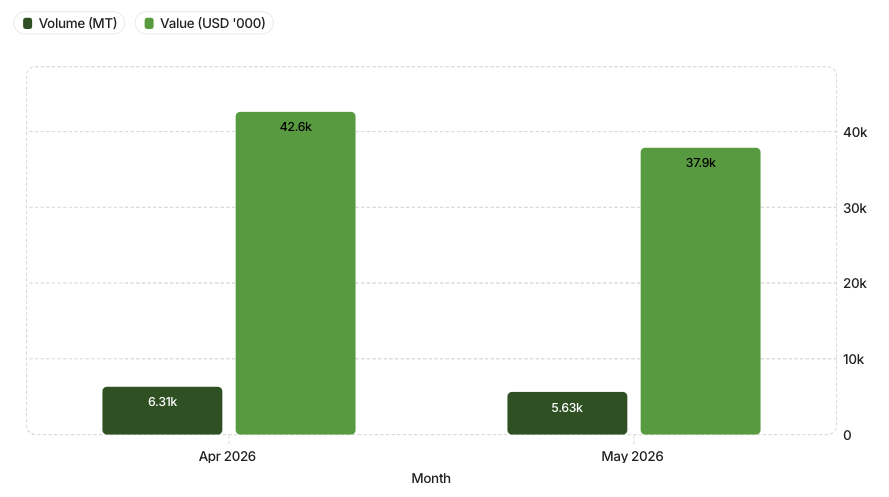
Looking at the monthly trajectory, the trend in May 2026 reinforces the picture of a softening market. May imports of 5,630 metric tons valued at USD 37.86 million represented month-on-month declines of 10.8% in volume and 11.1% in value compared to April. This sequential deterioration suggests that the demand weakness is not a one-off adjustment but an ongoing trend that importers and exporters alike must factor into their planning for the remainder of 2026. The cumulative effect of these monthly declines has significant implications for the full-year outlook, with the EU market unlikely to recover to 2025 import levels without a meaningful improvement in European economic conditions.
Vietnam’s Dominant Position: 62% Market Share Holds Firm
Despite the broader contraction in EU pepper imports, Vietnam’s position as the continent’s primary supplier remains unchallenged. During the first five months of 2026, Vietnam exported 15,430 metric tons of pepper to the EU, representing approximately 61.73% of total EU pepper imports from non-EU suppliers. While this share represents a slight decline from the 63.22% recorded in the same period of 2025, the erosion is marginal and does not signal any meaningful loss of competitive ground. In absolute terms, Vietnam’s export volume to the EU continues to dwarf that of any individual competitor.
Vietnam’s ability to maintain such a commanding market share in a declining market is itself a notable achievement. When total EU imports fall by 14.1%, a supplier that loses only 1.5 percentage points of market share has effectively outperformed the market average. This relative outperformance reflects the structural advantages that Vietnamese exporters enjoy: scale of production, established relationships with European buyers, and a pricing strategy flexible enough to remain competitive even as demand softens. European importers facing tighter budgets have not abandoned Vietnamese pepper — they have simply ordered less of it, while continuing to rely on Vietnam as their primary source.
Pricing Power: Vietnam’s Competitive Advantage Quantified
One of the most compelling aspects of Vietnam’s pepper export performance is its pricing competitiveness. With an average export price of approximately USD 6,633 per metric ton to the EU market, Vietnamese pepper maintains a clear cost advantage over key competitors including Indonesia, India, and Sri Lanka. This price differential is not incidental — it is the result of Vietnam’s scale economies, efficient supply chains, and the concentration of processing infrastructure in key growing regions such as Dak Lak, Gia Lai, and Ba Ria-Vung Tau.
The USD 6,633/MT average export price is particularly significant in the context of a weakening market. When European importers are reducing order sizes and scrutinizing costs more closely, a supplier that can offer competitive pricing without sacrificing reliability becomes even more valuable. Vietnam’s pricing advantage effectively creates a floor under its market share — even importers exploring diversification strategies find it difficult to justify switching to higher-priced alternatives when budgets are under pressure. This dynamic has helped Vietnam retain the bulk of its customer base even as some buyers incrementally increase orders from Brazil and Madagascar.
However, it is important to recognize that pricing advantage alone is not a sustainable long-term strategy. As competitors invest in productivity improvements and as the EU’s regulatory environment places greater emphasis on traceability, sustainability, and food safety, the gap between Vietnamese prices and those of competitors may narrow. Indonesian and Indian exporters, for example, have been making steady progress in improving their processing standards and reducing costs. Sri Lanka, while a smaller player, has carved out a niche in the premium organic segment where price is less of a deciding factor. Vietnam’s industry must therefore view its current pricing advantage as a platform from which to invest in differentiation, rather than as a permanent structural feature of the market.
Emerging Competition: Brazil, Madagascar & Sri Lanka Gain Ground
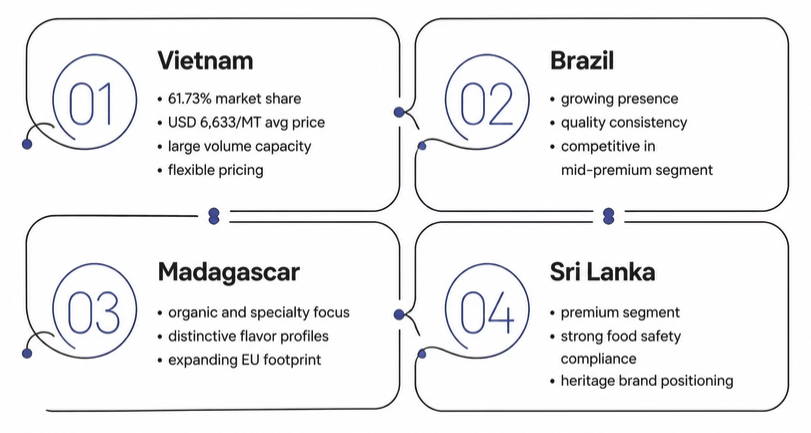
While Vietnam’s dominance remains secure in the near term, the competitive landscape in the EU pepper market is gradually shifting. Brazil, Madagascar, and Sri Lanka are each pursuing distinct strategies to expand their presence among European importers, and their incremental gains — though small in absolute terms — represent a meaningful trend that Vietnam’s industry cannot afford to ignore. These competitors are not simply competing on price; they are differentiating through origin branding, organic certification, and supply chain transparency — attributes that resonate increasingly with European buyers and consumers.
Brazil has emerged as a particularly noteworthy competitor, leveraging its large agricultural base and growing investment in pepper processing infrastructure. Brazilian pepper benefits from a perception of quality consistency and, in some segments, commands a price premium over Vietnamese product. Madagascar, meanwhile, has built a reputation for distinctive flavor profiles and has made significant inroads in the specialty and organic pepper segments, where European buyers are willing to pay higher prices for certified, traceable product. Sri Lanka’s strategy has focused on the premium end of the market, emphasizing its long heritage of spice production and its ability to meet stringent EU food safety requirements.
Strategic Imperatives: Securing Vietnam’s Long-Term Leadership
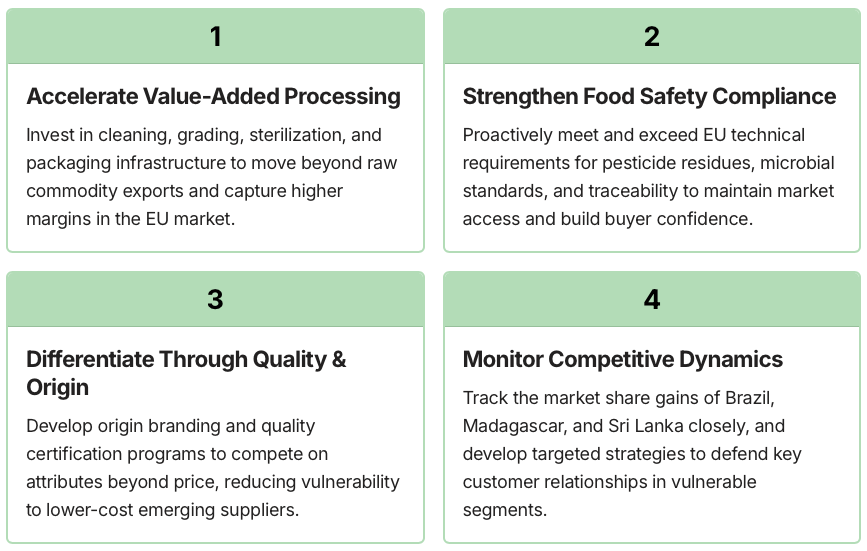
The fundamentals remain strong: dominant market share, competitive pricing, and a proven supply chain. However, the combination of a weakening EU market, incremental competitive gains by Brazil, Madagascar, and Sri Lanka, and the EU’s increasingly stringent regulatory environment creates an urgent imperative for Vietnam’s industry to evolve beyond its current volume-driven model. The window for proactive adaptation is open, but it will not remain open indefinitely.
The most critical priority for Vietnam’s pepper industry is accelerated investment in value-added processing. Currently, a significant proportion of Vietnamese pepper exports to the EU are in raw or minimally processed form, limiting the value captured by Vietnamese exporters and leaving the industry exposed to commodity price competition. By investing in processing infrastructure — including cleaning, grading, steam sterilization, packaging, and even further processing into pepper extracts and oleoresins — Vietnamese exporters can move up the value chain, command higher prices, and build more defensible relationships with European buyers who increasingly prefer ready-to-use, certified products.