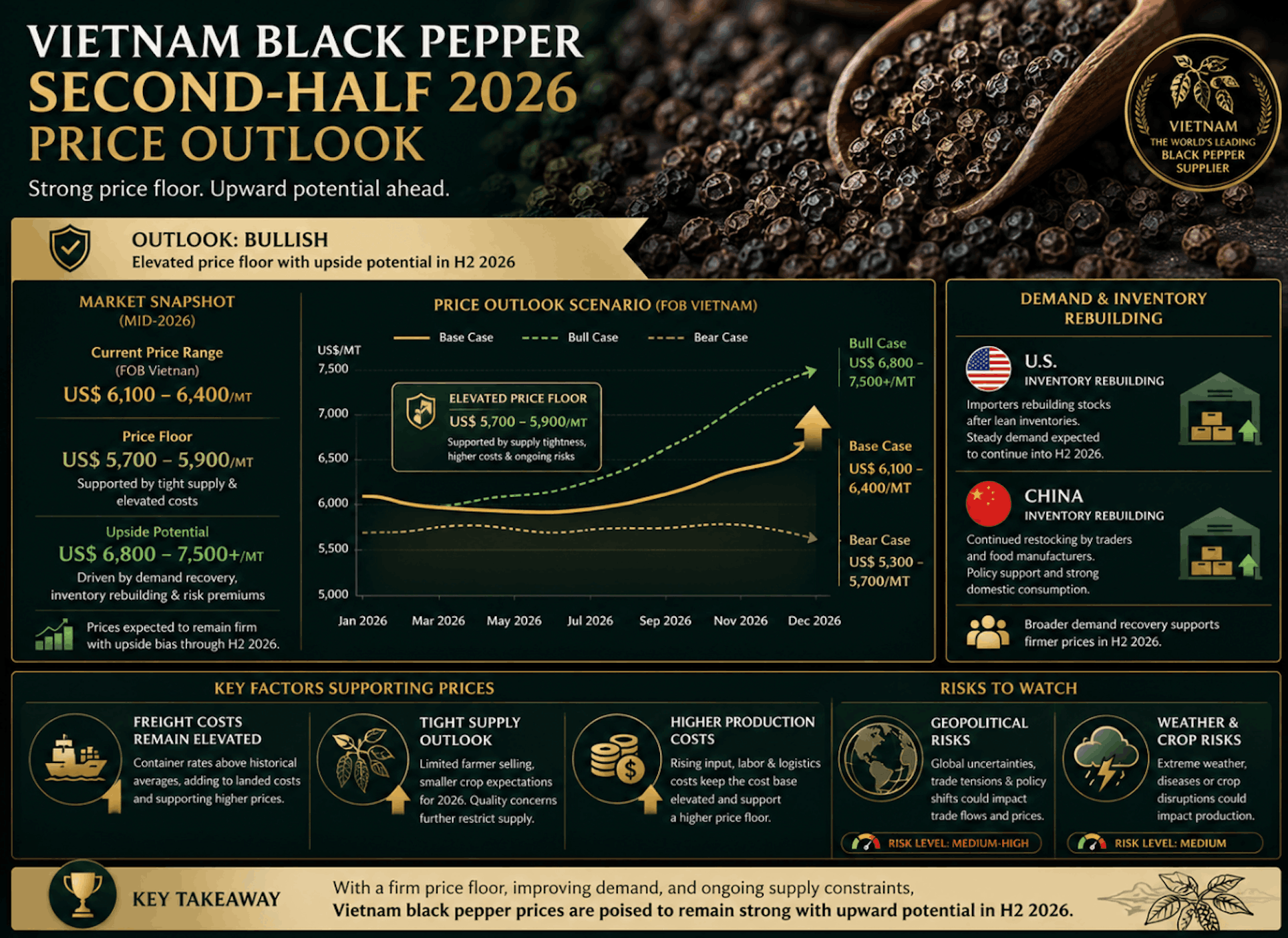



2026 // Week 30 – Vietnam Pepper Market Update: Pepper production is trending downward due to unfavorable weather conditions.
Current Price Dynamics: Stability Amid Volatility
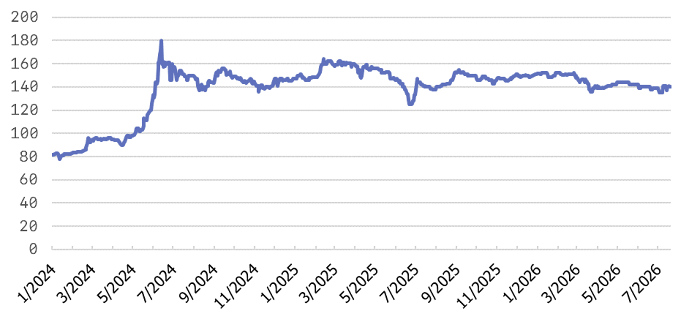
Pepper price developments in the Central Highlands and Southeast from First 2023 to 20-July, 2026 (Unit: VND/kg)
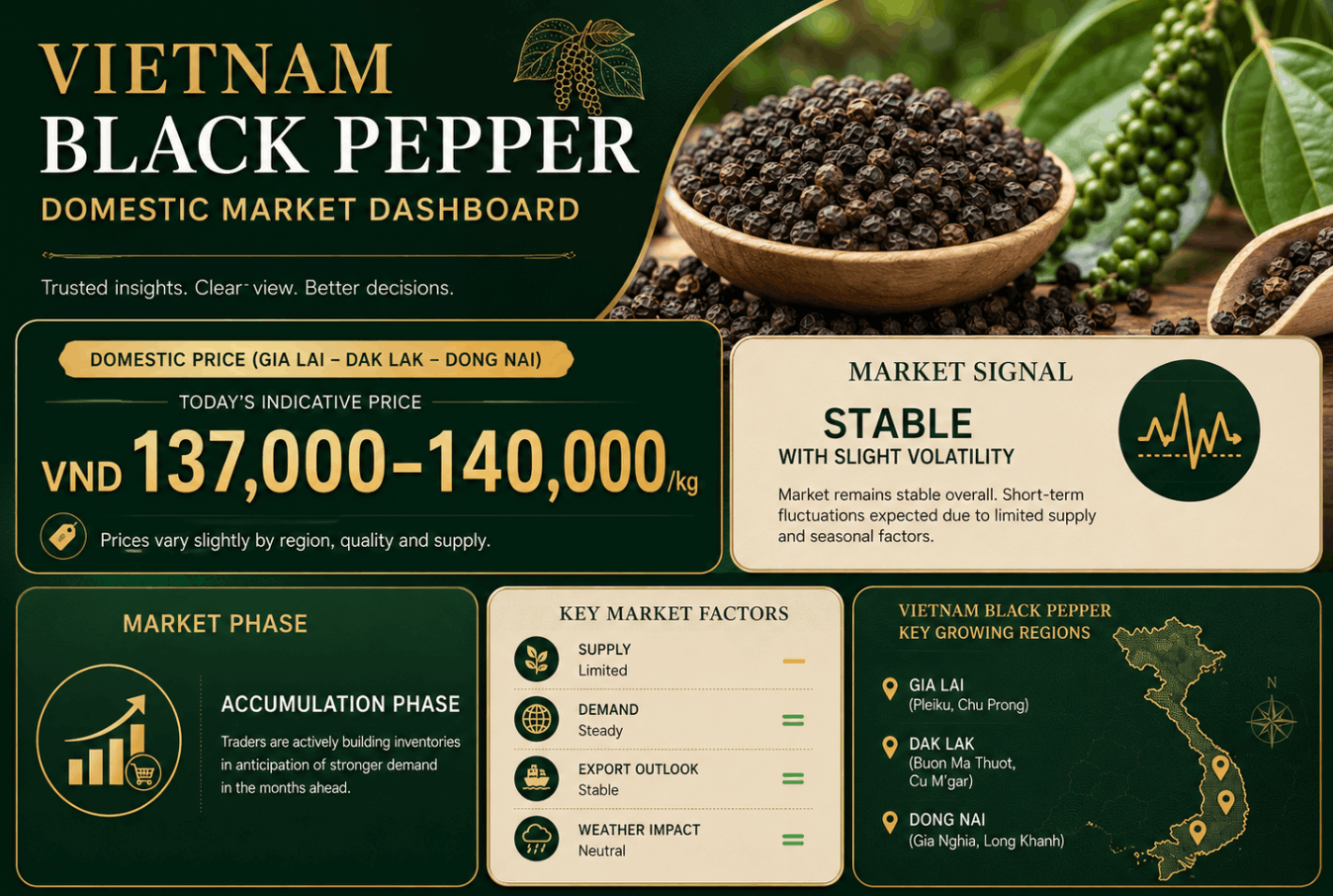
Domestic pepper prices are currently trading in the range of VND 137,000–140,000 per kilogram, reflecting a market caught in a classic tug-of-war between buyers and sellers. While the broader trend remains constructive, today’s session highlights the cautious posture that both sides have adopted following the modest recovery seen in previous trading sessions.
That earlier recovery prompted farmers and local traders to release additional stocks into the market, effectively capping further upward momentum. Speculative buying has not yet been strong enough to absorb the increased supply and sustain higher price levels. At the same time, the fact that prices are holding firmly above VND 137,000/kg signals that demand at lower price floors remains solid — a meaningful indicator of underlying market strength.
Market sentiment across the supply chain remains cautious. Exporters are reluctant to commit to large-volume contracts at current price levels, while growers are watching closely to determine whether to hold inventory or sell into the market. This standoff is characteristic of an accumulation phase, where neither bulls nor bears have established clear dominance.
Production Outlook: A Structurally Tightening Supply
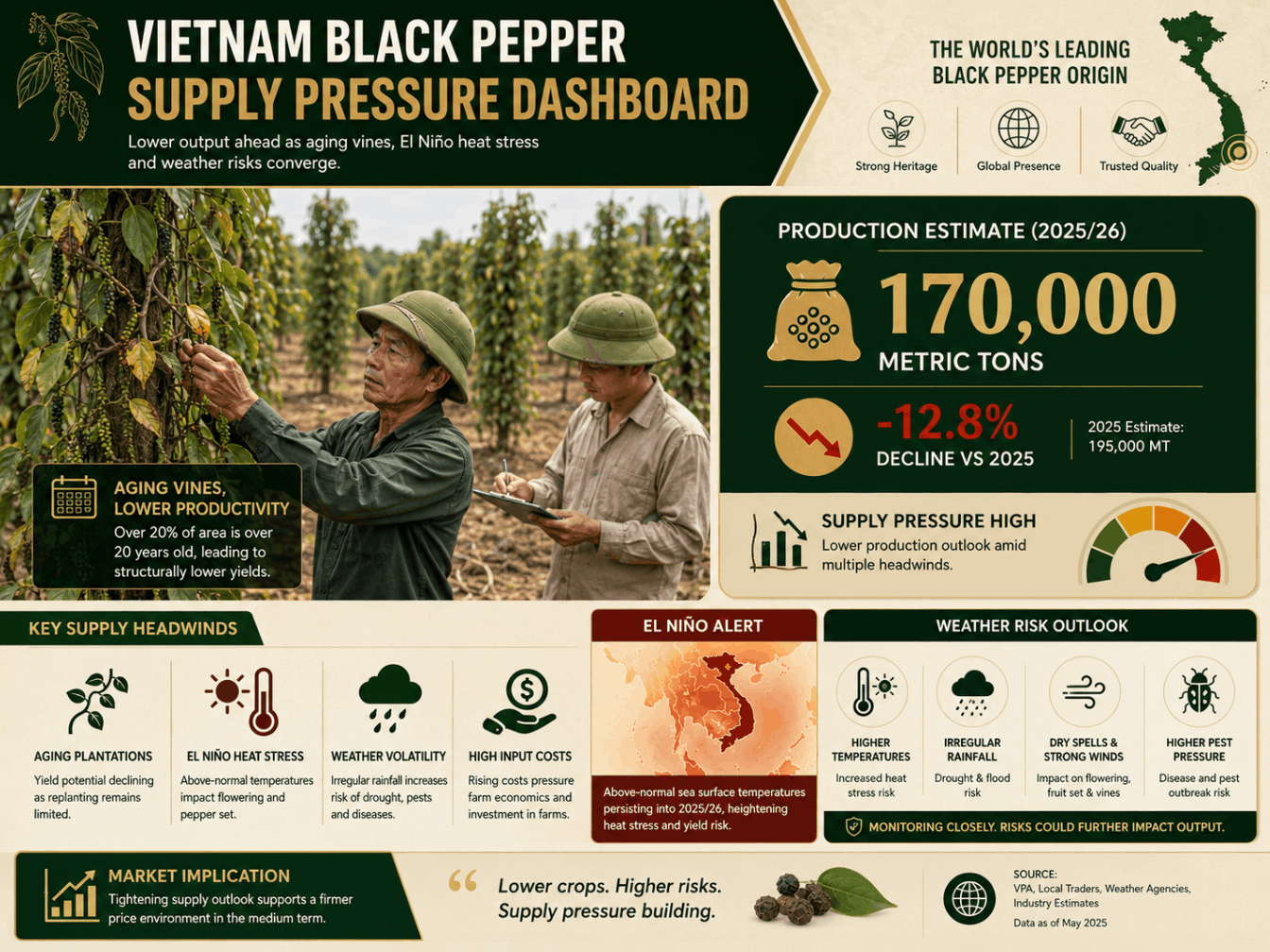
The most significant structural development in Vietnam’s pepper market is the sharp decline in domestic production. According to the Vietnam Pepper and Spice Association (VPSA), Vietnam’s pepper production in 2026 is estimated at approximately 170,000 metric tons — a 12.8% decline compared with 2025. This is not a temporary blip but rather the result of two powerful, compounding forces reshaping the country’s agricultural landscape.
Primary Drivers of Decline
- Crop substitution: Farmers are actively replacing aging pepper plantations with higher-value fruit crops, reducing the total harvested area dedicated to pepper.
- Extreme weather: Adverse weather conditions, including drought and irregular rainfall patterns, have significantly reduced yields across major growing regions.
- Aging plantations: A significant portion of Vietnam’s pepper stock is reaching the end of its productive life, and replanting rates have not kept pace.
The combination of these factors is creating a supply squeeze that will be felt throughout the remainder of 2026 and potentially into 2027. For traders and exporters, this means the era of abundant, low-cost Vietnamese pepper supply is increasingly behind us. Procurement strategies must account for a tighter, more competitive raw material environment where price volatility is likely to increase.
Export Performance: Strong Volume Growth Despite Raw Material Shortage
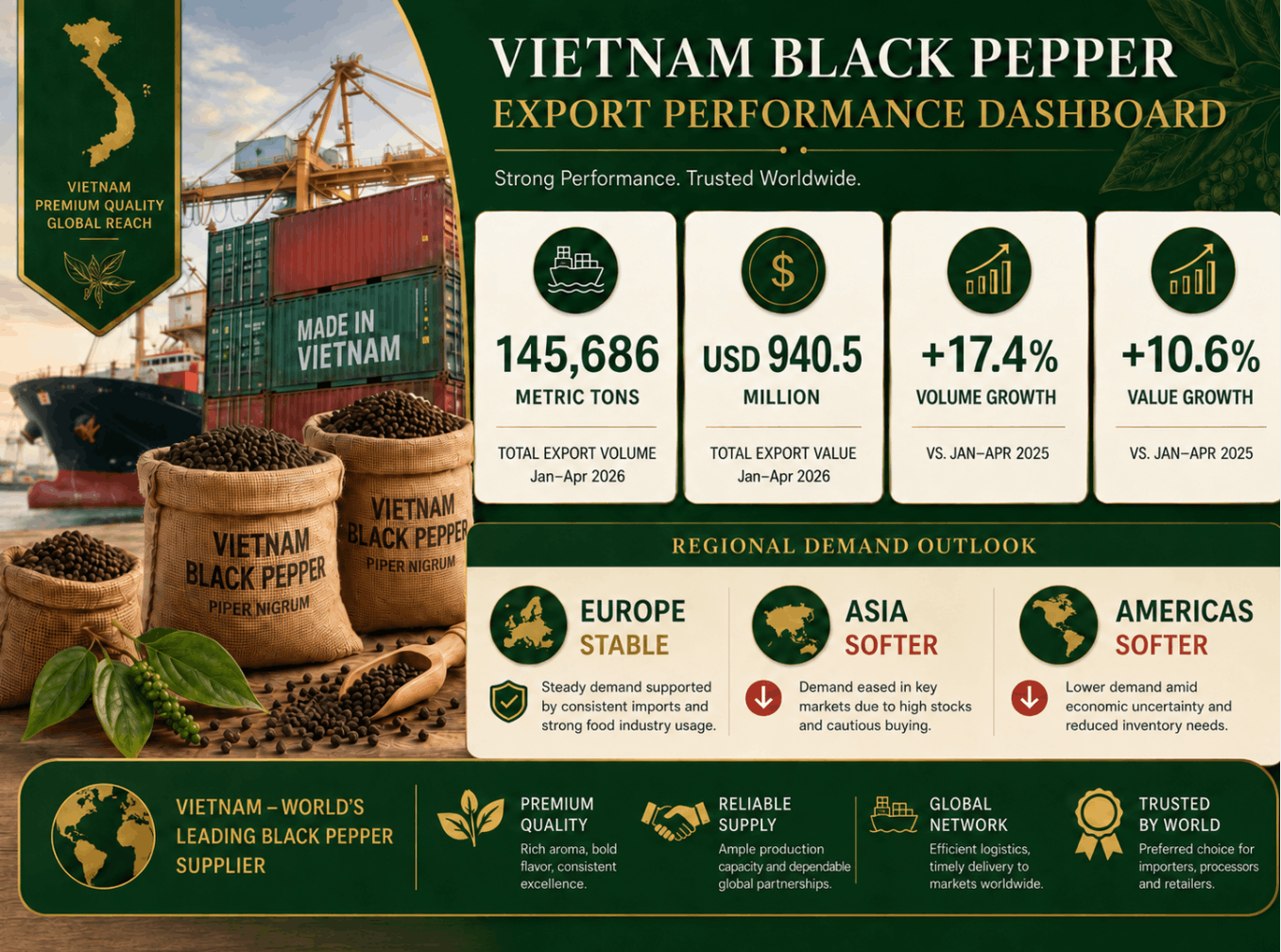
Vietnam’s pepper export data for the first half of 2026 tells a compelling story: despite a significant domestic production shortfall, the country continues to meet strong international demand. During January through June 2026, Vietnam exported 145,686 metric tons of pepper, generating USD 940.5 million in export revenue. This represents a 17.4% increase in volume and a 10.6% increase in export value compared with the same period in 2025.
The divergence between volume growth (+17.4%) and value growth (+10.6%) suggests that while more pepper is being shipped, average export prices have not risen proportionally — likely reflecting the mix of origin sources and competitive pricing pressure in certain markets. June specifically saw a slowdown in export activity, driven by weaker demand from Asia and the Americas. However, demand from Europe remained stable, providing a reliable anchor for Vietnamese exporters during a period of regional softness.
Regional Demand Split
Europe remained the most stable market. Asia and the Americas showed weaker demand in June, contributing to a temporary slowdown in export momentum.
Import Surge: Compensating for the Domestic Gap
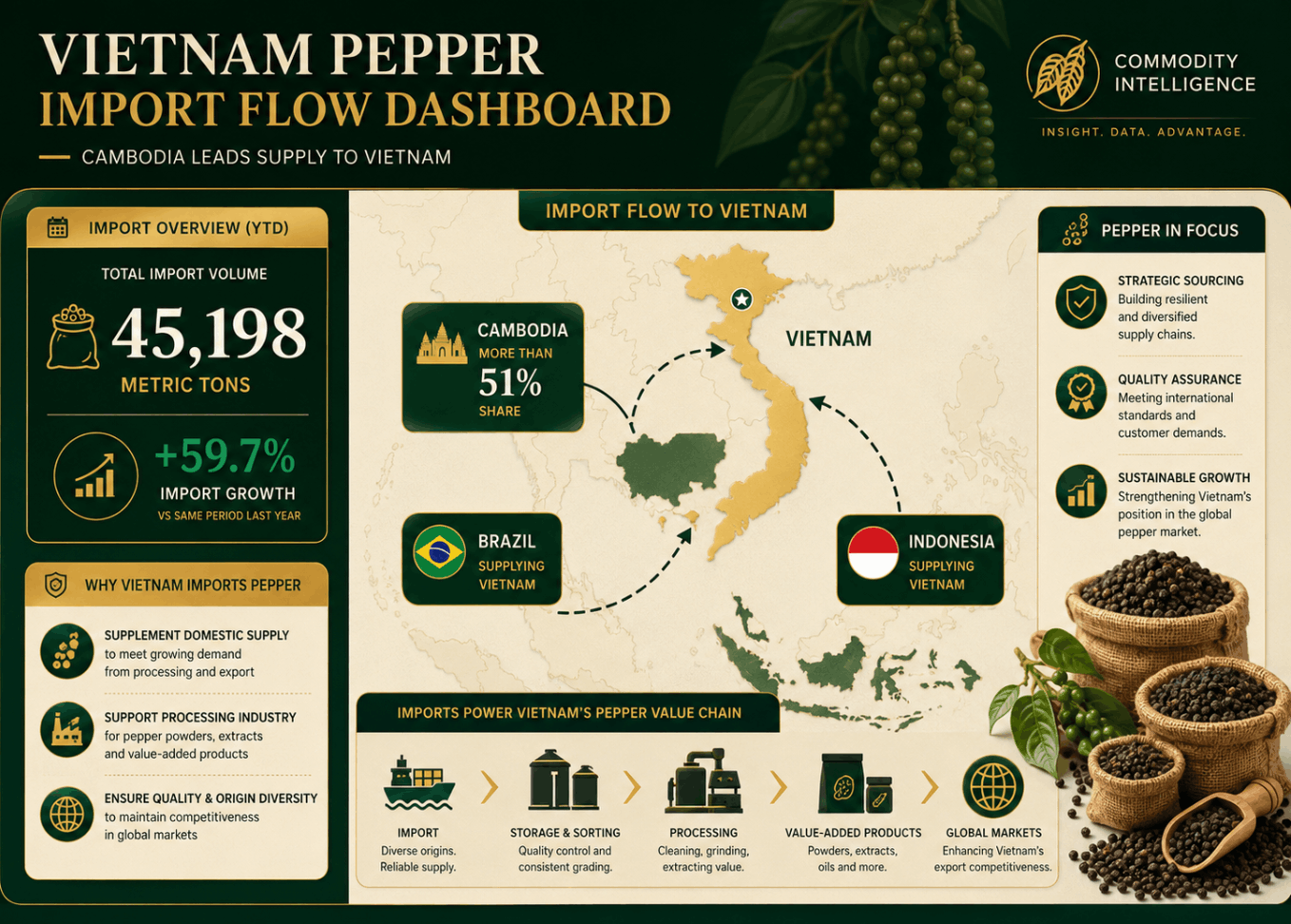
With domestic production falling sharply and export commitments remaining strong, Vietnamese exporters have turned to imports to fill the gap. During the first six months of 2026, pepper imports surged by 59.7% to reach 45,198 metric tons— a dramatic increase that underscores the severity of the domestic raw material shortage. This import activity is not speculative; it is a direct response to the need to fulfill existing export contracts that cannot be satisfied by domestic supply alone.
Top Import Sources
Cambodia — 51%+ of Total Imports
Cambodia remains Vietnam’s dominant pepper import source, supplying more than half of all imported volume. Geographic proximity and established trade relationships make Cambodia the natural first choice for Vietnamese importers.
Brazil
Brazil serves as a significant secondary source, offering competitive pricing and large-volume availability that helps Vietnamese exporters manage their procurement needs.
Indonesia
Indonesia rounds out the top three suppliers, providing additional volume flexibility and diversification for Vietnamese importers managing tight supply conditions.
The import surge is a direct function of the domestic production shortfall. Exporters are importing to fulfill contracts — this is operational necessity, not speculative positioning.
The heavy reliance on imports, particularly from Cambodia, carries strategic implications for the Vietnamese pepper industry. While imports provide a short-term solution, they also compress margins and introduce supply chain complexity. Over the longer term, the industry must address the structural production decline through replanting programs, improved agronomy, and potentially a shift toward higher-value, certified production that commands premium pricing.
Price Outlook: Elevated Levels with Further Upside Potential
Market experts expect domestic pepper prices to remain at elevated levels with further upside potential during the second half of 2026. The fundamental drivers — tightening domestic supply, continued strong procurement demand for export, and recovering demand from major importing markets — all point toward a supportive price environment. While higher logistics costs and geopolitical tensions could moderate the pace of gains, the overall directional bias remains positive.
United States & China Demand
The two largest buyers are expected to strengthen purchasing as inventories have fallen to historically low levels after several years of reduced buying. This inventory rebuild cycle should provide a significant demand tailwind for H2 2026.
Logistics & Geopolitical Risks
Higher logistics costs and ongoing geopolitical tensions could slow the pace of price appreciation. Market participants should factor in elevated freight rates and potential supply chain disruptions when modeling price scenarios.
European Market Stability
Europe has remained the most stable demand source throughout H1 2026. Continued stable procurement from European buyers provides a reliable floor for Vietnamese export volumes and supports price stability.
The inventory situation in the United States and China deserves particular attention. Both markets have been drawing down stocks for an extended period, and as those inventories approach critically low levels, the probability of a significant restocking cycle increases. This could trigger a sharp uptick in demand that outpaces the available supply response, creating conditions for accelerated price appreciation in Q3 and Q4 2026.
Structural Challenges: Weather, Regulations & the Path Forward
Beyond commercial supply and demand dynamics, Vietnam’s pepper industry faces a dual challenge from natural and regulatory forces that are reshaping the competitive landscape. These factors are not short-term headwinds — they represent structural shifts that will define the industry’s trajectory for years to come.
Climate & Weather Risks
The impact of El Niño and extreme weather conditions is expected to intensify later in 2026, posing a significant risk to production yields. Drought, irregular rainfall, and temperature extremes can devastate pepper crops at critical growth stages. For an industry already grappling with a 12.8% production decline, additional weather-related losses could exacerbate the supply squeeze and push prices even higher.
- El Niño patterns increasing drought risk in key growing regions
- Extreme weather reducing harvested areas and yields
- Climate volatility making production planning increasingly difficult
Regulatory & Sustainability Pressures
Markets such as the United States and European Union are imposing increasingly stringent requirements on pepper imports, including:
- Stricter sustainability standards and certification requirements
- Enhanced traceability obligations throughout the supply chain
- Tighter chemical residue limits and food safety regulations
These regulations are accelerating Vietnam’s transition toward organic and sustainable pepper production — a shift that is both a challenge and an opportunity for the industry.
The regulatory pressure, while costly in the short term, is ultimately driving Vietnam toward a more competitive and resilient industry structure. Organic and sustainably certified pepper commands premium pricing in Western markets, and early movers who invest in compliance and certification will be well-positioned to capture that premium as demand for responsibly sourced spices continues to grow.