



2026 // Week 33 – Vietnam Pepper Market Update : Price Remained Stable
Domestic Price Stabilization
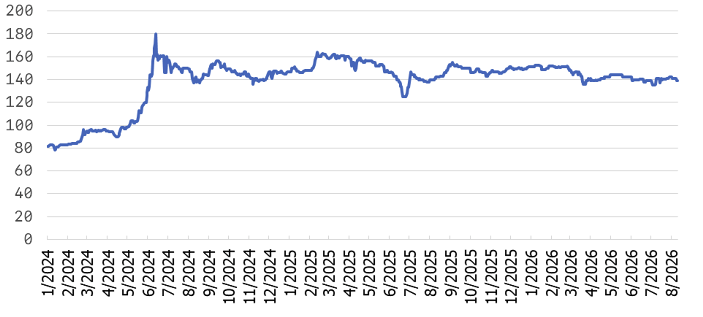
Pepper price developments in the Central Highlands and Southeast from First 2023 to 10-August, 2026 (Unit: VND/kg)
On August 10, 2026, Vietnam’s domestic pepper market recorded broadly unchanged prices, effectively pausing the downward momentum that had characterized recent trading sessions. After a decline of VND 2,000/kg in the previous session, prices settled into the VND 138,000–140,000/kg band across major producing provinces. This stabilization reflects a market in transition — no longer in freefall, but not yet showing the momentum needed for a meaningful recovery. The halt in the decline is significant because it suggests that the selling pressure which drove prices lower has begun to subside, at least temporarily.
The VND 3,000/kg price spread among major pepper-producing provinces remained unchanged, a signal that regional market dynamics are synchronized and that no single province is experiencing disproportionate selling pressure or demand strength. This uniformity across regions indicates that the market is attempting to establish a short-term price floor — a level at which sellers are generally unwilling to accept lower prices and buyers are not yet motivated to bid higher. Such floors often emerge after sharp declines as the market searches for equilibrium, though they can be fragile if export demand does not materialize to reinforce them.
Supply & Demand Dynamics
The current price stabilization is underpinned by a confluence of supply and demand factors that are, for now, working in tandem to prevent further declines. On the supply side, domestic availability has tightened as farmers reduce their willingness to sell at lower prices — a natural response after absorbing recent losses. This behavioral shift effectively reduces the volume of pepper flowing through local trading channels, creating a supply-side buffer that supports prices even in the absence of surging demand. When farmers hold back inventory, it signals that the market price has approached a level that sellers find unacceptable, which historically has been a precursor to price stabilization or recovery.
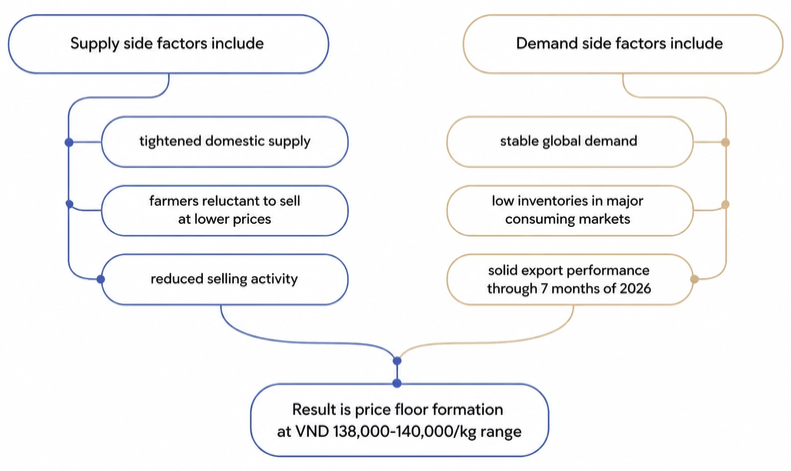
On the demand side, inventories in major consuming markets remain low, according to the Vietnam Pepper and Spice Association (VPSA). Low inventory levels in destination markets typically create pent-up purchasing demand, as importers and processors need to replenish stocks to meet ongoing consumption requirements. This dynamic provides a latent source of support for Vietnamese export prices, as buyers with depleted inventories may need to enter the market more actively in coming weeks. However, the translation of low inventories into actual purchasing orders depends on factors such as price expectations, currency conditions, and the availability of alternative sourcing options — all of which influence the timing and volume of exporter procurement.
Export Performance: Strong First Seven Months
Vietnam’s pepper export sector delivered solid results through the first seven months of 2026, providing a fundamental support pillar for domestic prices. Total exports reached 168,429 metric tons, generating USD 1.087 billion in revenue. These figures represent year-over-year increases of 16.1% in volume and 10.1% in value compared with the same period in 2025. The divergence between volume growth and value growth — volume rising faster than value — suggests that average export prices per metric ton were slightly lower than in 2025, though the overall revenue increase still reflects strong global demand for Vietnamese pepper. This export strength is particularly important for the domestic market because sustained export purchasing helps absorb supply and prevents inventory buildup that would otherwise weigh on farmgate prices.
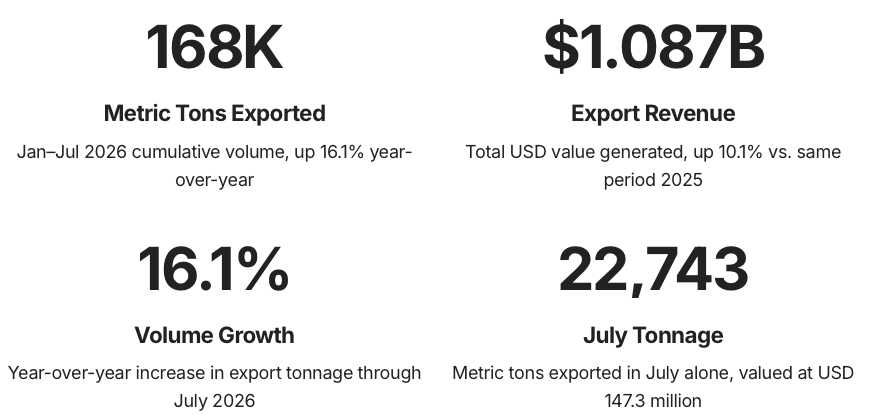
July 2026 exports totaled 22,743 metric tons valued at USD 147.3 million. While this represented a slight easing from June’s figures, July exports were still 8.8% higher than in July 2025, confirming that the underlying export trend remains positive. The month-over-month moderation from June to July is not unusual in seasonal trading patterns and does not necessarily signal weakening demand — rather, it may reflect normal fluctuations in shipment scheduling and contract fulfillment cycles. What matters more for market participants is the cumulative picture: seven months of year-over-year growth in both volume and value demonstrates that global buyers continue to rely on Vietnam as a primary pepper source.
Market Outlook: Consolidation Expected
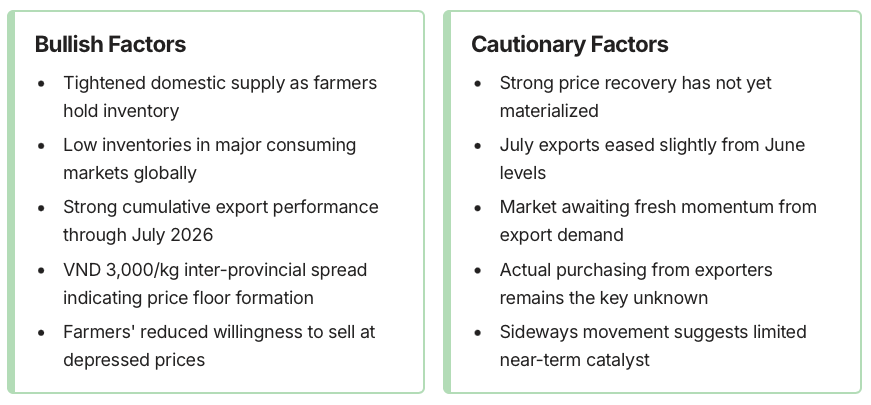
According to the Vietnam Pepper and Spice Association (VPSA), domestic pepper prices are expected to continue consolidating within the VND 138,000–140,000/kg range in the near term. A significant price decline is considered unlikely given the tightening of domestic supply and the low inventory levels observed in major consuming markets abroad. These conditions create a supportive floor that should prevent the kind of sharp downward moves seen in recent sessions. However, the VPSA also cautions that a strong price recovery has not yet emerged, meaning that while the downside risk appears limited, the upside potential remains constrained until actual purchasing demand from exporters increases.
Market Focus for Farmers & Traders
Given the current market environment — characterized by price stabilization, tightening supply, and awaiting export demand momentum — both farmers and traders are advised to adopt a measured, information-driven approach to marketing decisions in the coming trading sessions. The VPSA’s outlook suggests that while the risk of a sharp further decline has diminished, the catalyst for a meaningful price recovery has not yet arrived. This creates a window in which careful decision-making can help market participants optimize their positioning without exposing themselves to unnecessary risk.
Monitor Exporter Demand Closely -> Avoid Panic Selling at Current Levels -> Plan Marketing Around Export Calendars -> Watch for Breakout Signals
The overarching message from the VPSA and the current market data is one of cautious optimism. The fundamental conditions that typically support price recovery — tight supply, low global inventories, and strong export volumes — are present. What remains absent is the active purchasing demand from exporters that would translate these conditions into upward price momentum. Farmers and traders who stay informed, avoid reactive decisions, and align their strategies with actual market signals will be best positioned to capitalize when the market moves beyond its current consolidation phase.